
Digits vs. Mercury Books
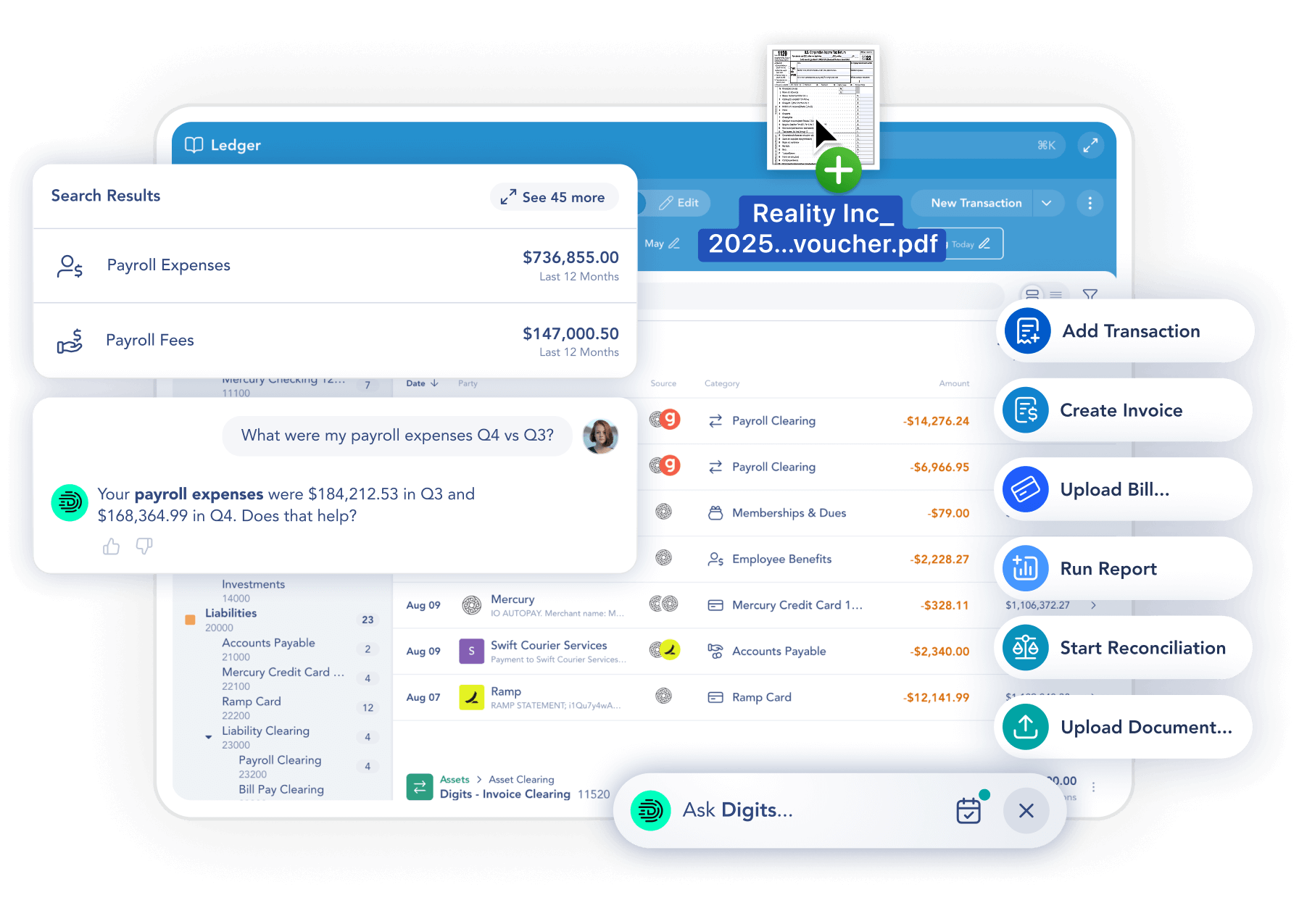
Which accounting platform is best for modern businesses & firms?
The pace of modern finance doesn't wait for rules, clicks, and month-end marathons.
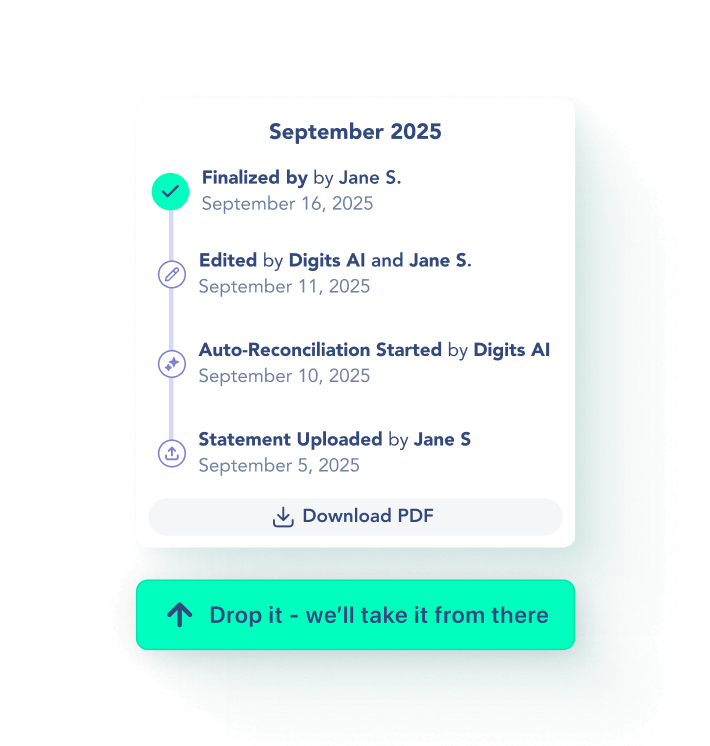
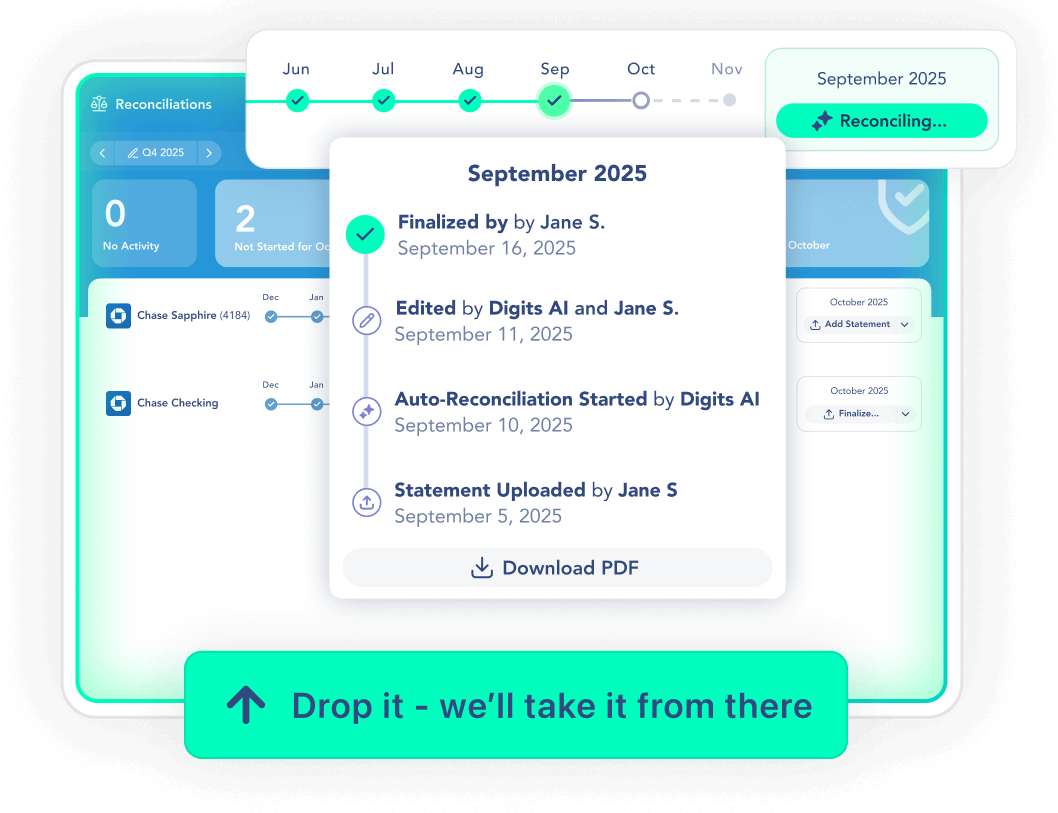
Digits is an AI-native accounting platform that reconciles to bank statements, runs continuous quality control checks, detects and drafts schedules, and unlocks unlimited collaboration—no rules, no scripts, no seat limits.
What we compare
Where AI actually does the work, how teams collaborate, which reports drive decisions, and what you'll really pay.
Digits Core $100/mo vs. Mercury Books $35/mo (requires a Mercury bank account)
Features change—verify on vendor pages.

Built for AI, not before AI
Digits Core
Mercury Books
Digits is the ledger and accounting system of record.
Books is the ledger and system of record, but only for businesses that hold a Mercury bank account.
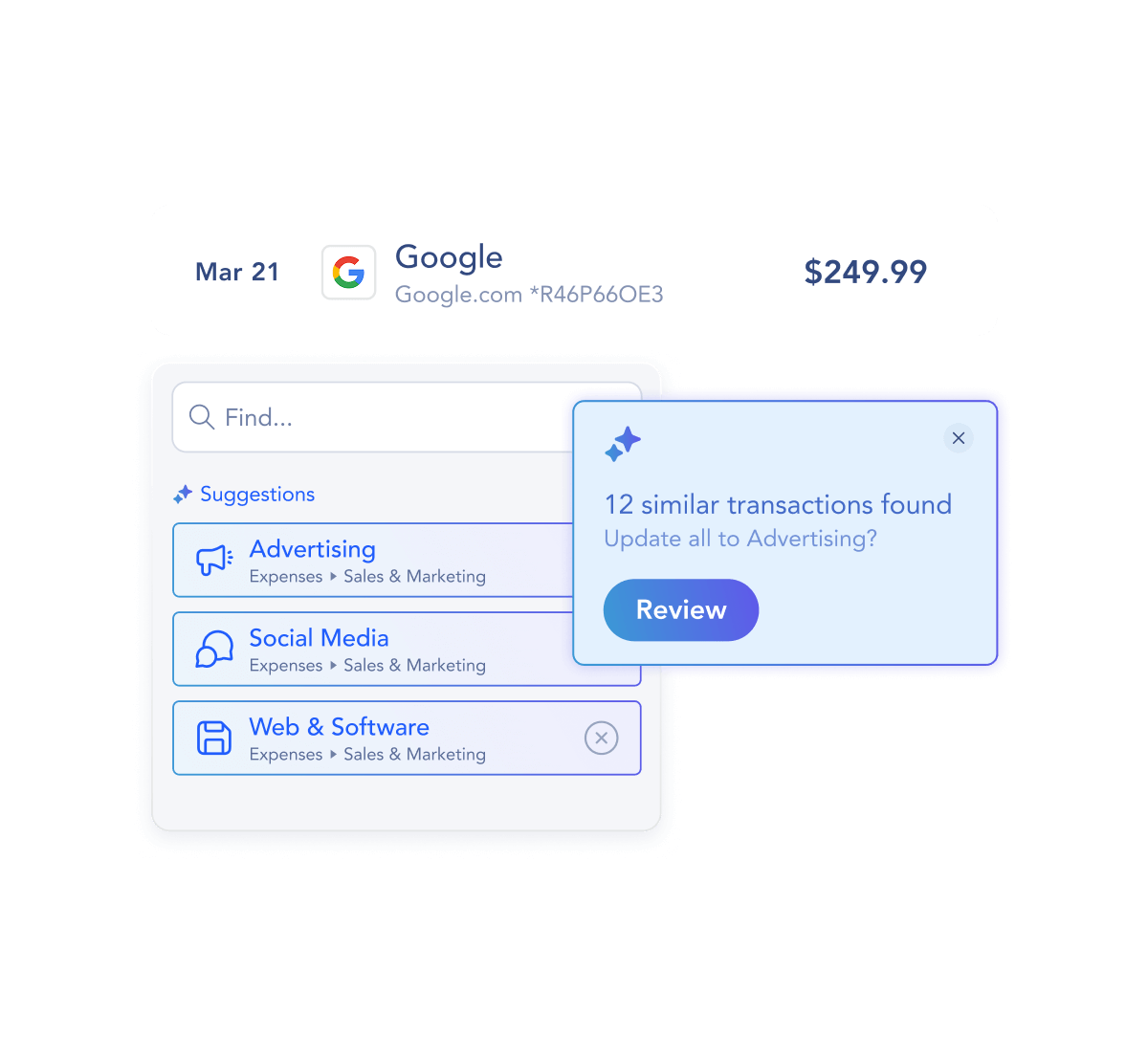
AI isn't a feature; it's the foundation. Digits is AI-native from day one, powered by the Agentic General Ledger™ (AGL®). Proprietary models built for accounting and trained on 180 million real transactions representing nearly $1 trillion in financial activity auto-book, reconcile, and review continuously, then surface only the exceptions that need a human.
AI is the last step in categorization, after rules and past-transaction matches. Command adds a chat assistant. No published benchmarks, accuracy figures, or training details.
Digits automatically reconciles your accounts to bank statements (uploaded or connected) and flags only what needs review, so you can trust your numbers without doing the busywork. Reconciliation happens continuously, not just at month-end.
Mercury accounts reconcile automatically. External accounts are reconciled by hand: enter the statement balance, get the difference, and find the cause yourself.
Ask Digits is your ledger-native assistant, purpose-built for accounting. It understands your financial data and answers questions directly. It is not a chat layer sitting on top of reports.
Command is built into Books and answers questions from ledger data. Drafts journal entries and bulk recategorizations for approval.
AI does the routine work; you manage the exceptions. Exceptions and items flagged for review land in the Checklist, grouped by close step: uncategorized or low-confidence transactions, missing or duplicate items, schedule candidates, quality control flags, and open comments. With Digits Checklist, you review the close instead of preparing it.
No exception queue. Reconciliation shows a balance difference only; nothing is flagged. Uncertain items sit uncategorized until someone codes them; the rest you scan yourself.
Describe a Quality Control check in plain English. Digits Quality Control checks are deterministic and run the same way across your entire financial history, on every transaction, every time.
No quality control feature. Review is manual: filter by how transactions were categorized, scan, and correct. Checks cannot be defined.
Digits automatically detects and drafts schedules directly in the ledger. After accountant approval, Digits automatically generates recurring entries for prepaids and fixed assets.
No schedules feature. Prepaid, fixed-asset, and deferred revenue entries are booked by hand each period, or drafted one at a time by asking Command.
More than automation. Built for scale.
If you're comparing platforms to find the best AI accounting software, don't stop at task automation. Digits pairs the Agentic General Ledger™ with what real-world finance teams need: unlimited users, built-in comments, departments and locations, plus bill pay, invoicing, and documents in the same ledger.
Features & Limits beyond AI
Digits Core
Mercury Books
Unlimited users included —team, advisors, and auditors at no extra cost. Plans are billed on a per-business (or per-client) basis, not per seat.
Unlimited advisor seats; no user limit published. Included with Books at no extra cost.
Built‑in comments and @mentions on transactions, bills, categories, reconciliations and more. Checklist gathers every open question and action item in one place, by workflow step.
Shared access to the books plus an Advisor Portal. No in-line comments, shared dashboards, client portal, or action-item inbox.
Departments and Locations are included with dimensional dashboards and statement slicing. (Projects coming soon.)
Tags serve as departments. Reports filter by one tag at a time; side-by-side comparisons require an export.
12,000+ banks & cards via Plaid, plus Gusto, Ramp, BILL, Stripe, Mercury, and Reach Reporting; bank statements auto‑fetched to Documents for many institutions; PDF‑to‑CSV where supported.
Built around Mercury accounts; other banks and cards come in through Plaid with no statement fetching. Three integrations: Stripe, PayPal, and Gusto, the only payroll option.
AI Bill Pay and AI Invoicing included—digitized documents, auto-extracted vendor data, smart categorization, and streamlined approvals.
Bill pay and basic invoicing are included with the Mercury account. Recurring invoices are a $30/mo add-on. Matches payments to invoices and bills, including partial payments.
One tool, no bolt-ons. Bill pay, invoicing, documents, and reconciliation run in the same system as your ledger.
Ledger, banking, cards, payments, and invoicing under one Mercury login. A Mercury bank account is required. Prior ledger history comes over through a white-glove migration, not self-serve.
Trusted by 7,000+ accountants and business owners



















This is a fundamentally unique experience for our clients, allowing our professionals to spend more time helping clients get value from their financial data and make informed business decisions. Even more so than before, we can provide business consulting services that move our clients forward.

Digits simplified everything on the financial side. What used to take me four hours a day now takes just 15–20 minutes.

Digits is INCREDIBLE! So intuitive, interactive, very easy to pickup and finally gives the right information beyond spreadsheets.

Digits combines a sleek dashboard with deep, nuanced insights — it's the perfect balance.

I don't spend time on accounting — and I love that.

Sleek interface, world-class support — I save hours every month at close.

Digits AI Invoicing makes managing my finances effortless. Everything's in one place—no more platform hopping.

The smoothest invoicing tool I've used. Everything just works, and billing takes a fraction of the time.

Digits saves 6 hours per client and helps us deliver deeper insights.

The future of accounting isn't crunching numbers — it's managing the tools that do. That's why I love Digits.

You don't have to sell me, the software sells itself.

A year in, my experience has been fantastic. Digits is the best AI-native accounting software available today — I’m so impressed that I only take on clients willing to use it.


Which Platform Is Right for You?

Digits Core
Is best for:
- Teams that want AI-prepared bank reconciliations, with missing transactions and mismatches flagged for review.
- Firms ready to standardize client accounting without requiring every business to open a Mercury account.
- Buyers who want published AI benchmarks and clear evidence of how accounting accuracy is measured.
Mercury Books
May be better for:
- Businesses comfortable tying their accounting platform to an active Mercury banking relationship.
- Teams willing to reconcile external accounts manually while Mercury accounts reconcile automatically.
- Startups starting fresh books, with no prior ledger history to bring over.
Frequently asked questions
Digits is an AI-native accounting platform that works with any bank. Mercury Books is accounting built around a Mercury account: it reconciles Mercury accounts automatically, but external accounts are reconciled by hand. Digits matches bank and card statements from every connected institution to the ledger, prepares the reconciliations, and flags missing transactions, potential duplicates, and date mismatches for review, so your team resolves exceptions instead of checking every statement line. It also brings automated bookkeeping, automated quality control, and automated schedules into the same ledger. The more banks a business or firm uses, the wider the gap.
Mercury Books automatically reconciles Mercury accounts, but external accounts follow a manual reconciliation process. Users obtain the statement, start the reconciliation, enter its ending balance, and investigate differences.
Digits automatically compares bank and card statements with ledger activity across supported accounts. It prepares reconciliations and flags discrepancies for review, without requiring users to build matching rules. That makes Digits especially useful for businesses with accounts across several financial institutions.
Yes. Digits integrates with Mercury, so you can keep your Mercury banking relationship and use Digits as your accounting system. You can also connect other supported banks, cards, payroll, and financial tools to the same Digits ledger.
For supported accounts, Digits can automatically collect bank statements. When automatic collection isn't available, you can upload statements for reconciliation. Using Mercury for banking does not require choosing Mercury Books for accounting.
Digits is a strong choice for firms that want to standardize client accounting across different banking relationships. Its accounting platform combines bookkeeping, reconciliation, schedules, and review, while firm-specific tools add portfolio oversight, firm-level intelligence, custom review checks, and branded client delivery.
Digits runs on the Agentic General Ledger™ (AGL®), a proprietary, accounting-specific model architecture. AGL® handles routine transaction work and routes uncertain items to the Checklist for review. Mercury Books documents a three-stage categorization process using rules, similarity to prior transactions, and AI, and its Command assistant can answer questions and carry out approved financial tasks.
Digits publishes its accuracy. In its 2026 benchmark, Digits AGL® achieved 97.8% transaction-categorization accuracy, scored against ground truth established by U.S.-based GAAP accountants, outperforming every frontier AI model tested; no general-purpose LLM exceeded 81% one-shot. Mercury Books was not part of that benchmark and does not publish an accuracy figure of its own, so there is no head-to-head ranking. Buyers can examine Digits' published methodology; there is no equivalent to examine for Mercury Books.