
Digits vs. Kick
Which accounting platform is best for modern businesses & firms?
The pace of modern finance doesn't wait for rules, clicks, and month-end marathons.
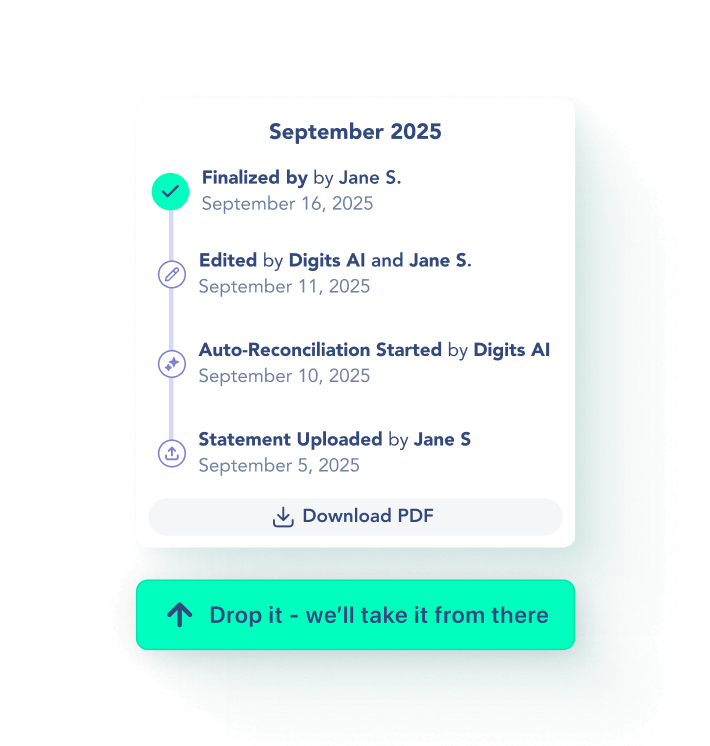
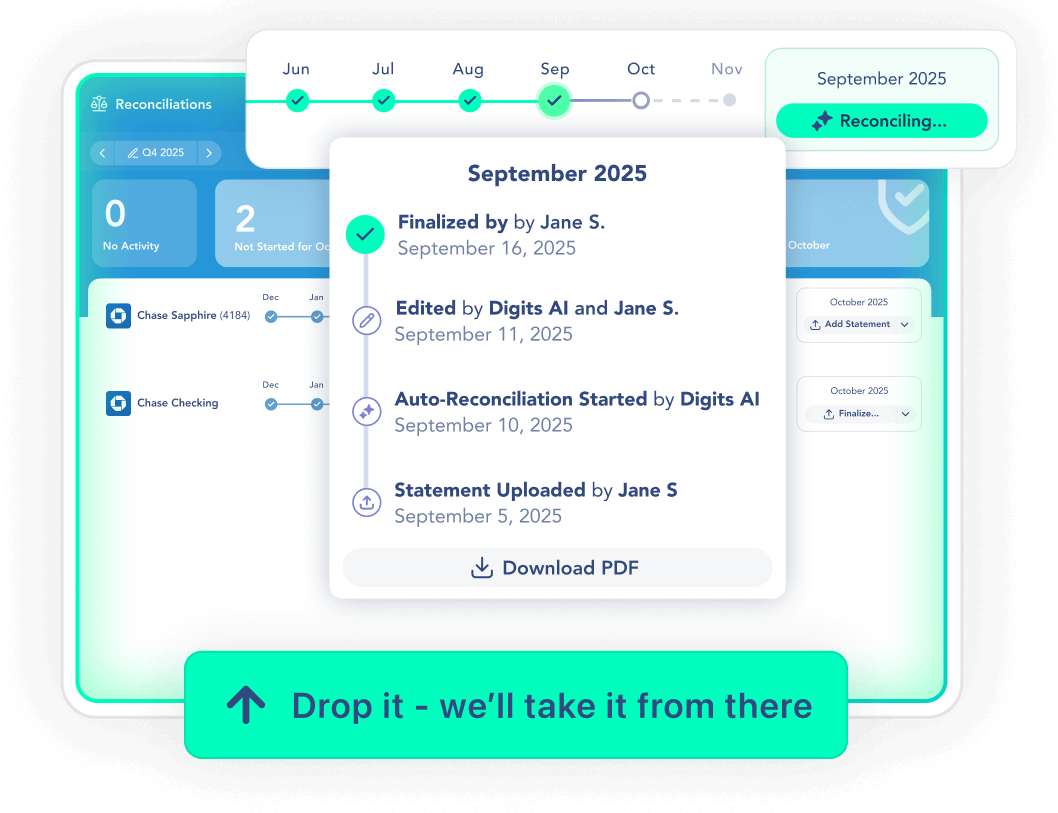
Digits is an AI-native accounting platform that reconciles to bank statements, runs continuous quality control checks, detects and drafts schedules, and unlocks unlimited collaboration—no rules, no scripts, no seat limits.
What we compare
Where AI actually does the work, how teams collaborate, which reports drive decisions, and what you'll really pay.
Digits Core $100/mo vs. Kick Plus $100/mo
Features change—verify on vendor pages.

Built for AI, not before AI
Digits Core
Kick Plus
Digits is the ledger and accounting system of record.
The ledger and system of record.
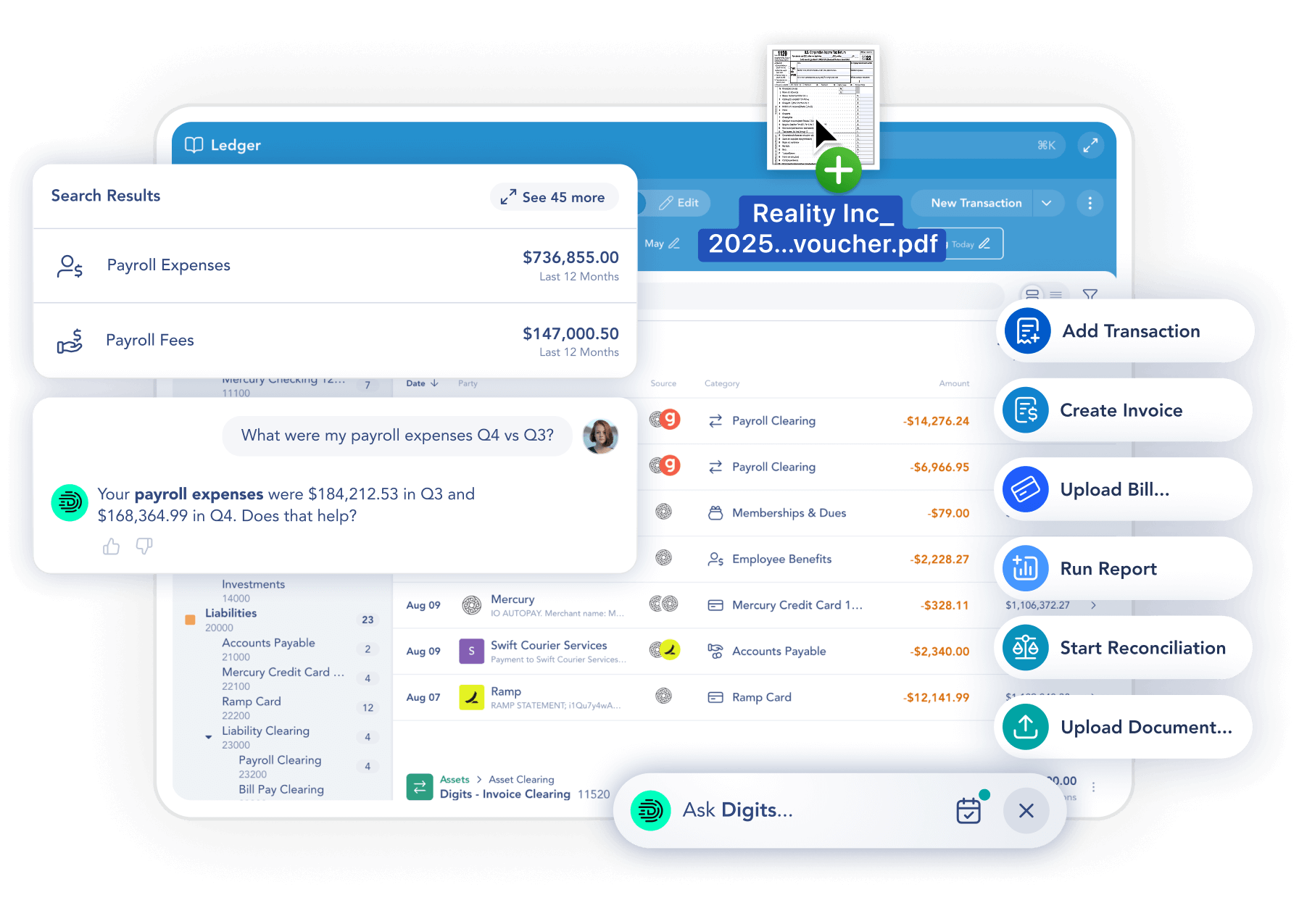
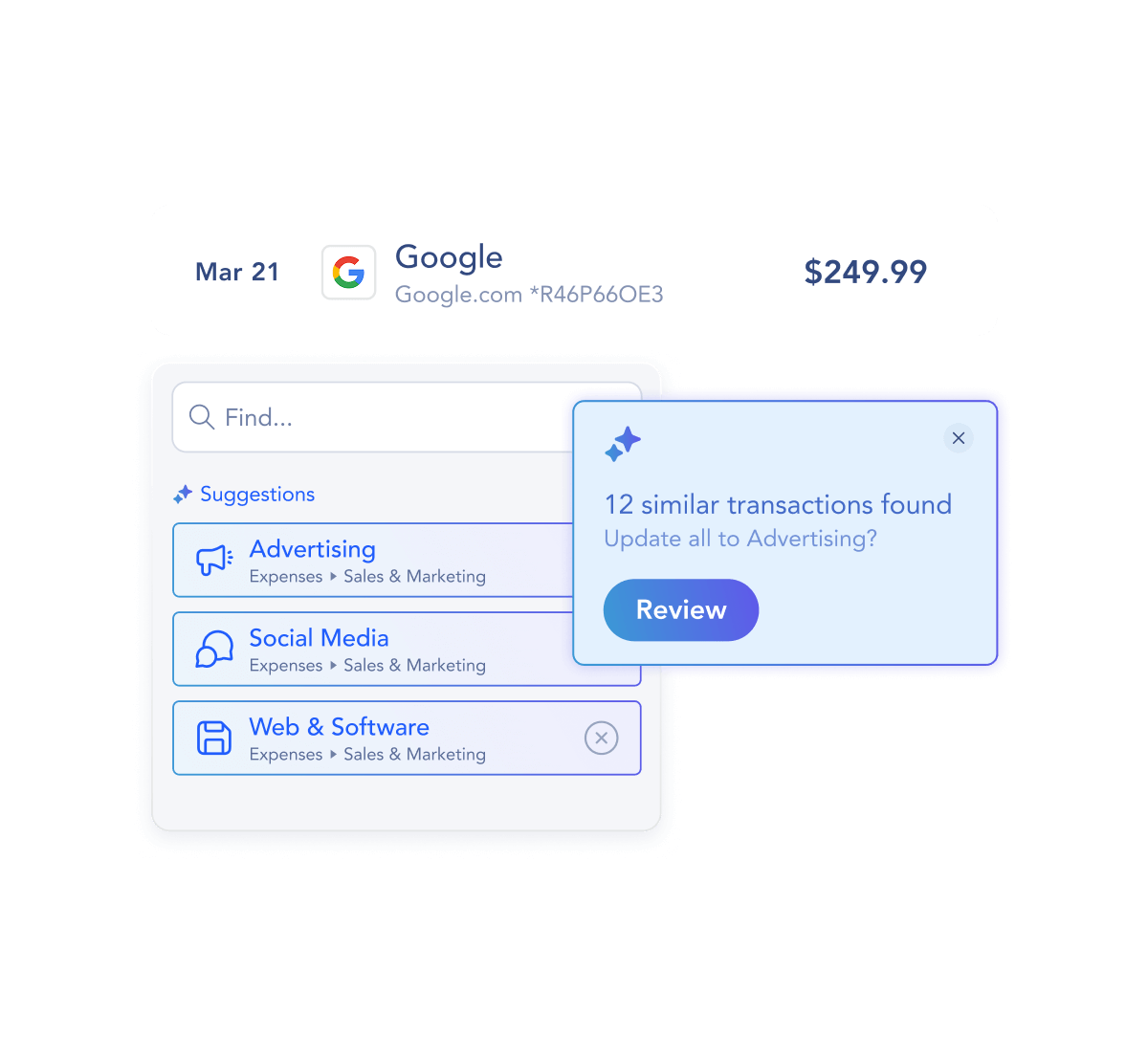
AI isn't a feature; it's the foundation. Digits is AI-native, powered by the Agentic General Ledger™ (AGL®). Proprietary models built for accounting and trained on 180 million real transactions representing nearly $1 trillion in financial activity auto-book, reconcile, and review continuously, then surface only the exceptions that need a human.
Uses bank data and user-defined rules to automate categorization, but it doesn’t publicly disclose the AI engine, how it’s trained, or any performance benchmarks.
Digits automatically reconciles your accounts to bank statements (uploaded or connected) and flags only what needs review, so you can trust your numbers without doing the busywork. Reconciliation happens continuously, not just at month-end.
Relies on user-built categorization rules and guided, statement-based reconciliation, where you run the process and approve matches—automation helps, but it doesn’t continuously reconcile in the background.
Ask Digits is your ledger-native assistant, purpose-built for accounting. It understands your financial data and answers questions directly from the ledger. It is not a chat layer sitting on top of reports.
No ledger-wide Q&A assistant is documented; Kick focuses on an ‘Actions’ feed of prompts and recommendations rather than conversational, ledger-native Q&A.
AI does the routine work; you manage the exceptions. Exceptions and items flagged for review land in the Checklist, grouped by close step: uncategorized or low-confidence transactions, missing or duplicate items, schedule candidates, quality control flags, open comments, and more. With Digits Checklist, you review the close instead of preparing it.
Review-queue suggestions, not exception flags. Kick proposes statement-match fixes (missing/duplicate/date) for approval, and categorization cleanup is mostly filter anything "Uncategorized" and edit.
Describe a Quality Control check in plain English. Digits turns it into a deterministic check that runs the same way on every transaction, continuously. Built-in checks: missing fields, miscoding, duplicates, unusual activity, account validity, vendor changes, and more.
No quality control feature. Accuracy depends on user verification.
Digits automatically detects and drafts schedules directly in the ledger. You can also create a new one or import a schedule. After accountant approval, Digits automatically generates recurring entries for prepaids and fixed assets.
No schedules module. Depreciation, prepaids, and deferred revenue are recurring journal entries you set up by hand.
More than automation. Built for scale.
If you're comparing platforms to find the best AI accounting software, don't stop at task automation. Digits pairs the Agentic General Ledger™ with what real-world finance teams need: unlimited users, built-in comments, departments and locations, plus bill pay, invoicing, and documents in the same ledger.
Features & Limits beyond AI
Digits Core
Kick Plus
Unlimited users included—firms, clients, CFOs, operators, auditors, all at no extra cost.
Invite teammates/advisors with role-based permissions (accountants/bookkeepers supported).
Built‑in comments and @mentions on transactions, bills, categories, reconciliations and more. Checklist gathers every open question and action item in one place, by workflow step.
Shared workspace access that tracks changes rather than built-in commenting.
Visualize your business’s financial health. Real-time P&L, Balance Sheet, Cash Flow, and AR/AP Aging with drill-through to transactions and export. Drag-and-drop KPIs and statements as tiles.
Real-time financial insights with downloadable reports and exports; a drag-and-drop dashboard builder is not documented publicly.
Departments and Locations are included with dimensional dashboards and statement slicing. (Projects coming soon.)
Segmentation via Classes for grouping transactions and reporting by category.
12,000+ banks & cards via Plaid, plus Gusto, Ramp, BILL, Stripe, Mercury, and Reach Reporting; bank statements auto‑fetched to Documents for many institutions; PDF‑to‑CSV where supported.
Banks & cards via Plaid, plus direct integrations (e.g., Stripe, Gusto, Ramp, Mercury, PayPal, Relay).
Read and write your ledger from AI tools. The Digits API and Digits MCP read from and write to the Digits ledger from AI tools like Claude, ChatGPT, Cursor, and Perplexity. Send raw transactions and Digits AGL® books, categorizes, and enriches them into clean entries, all governed by your existing Digits permissions.
Read and write MCP. Claude, ChatGPT, Cursor, and Perplexity can categorize and create transactions, journal entries, invoices, and bills with preview-and-confirm. API enabled on request.
AI Bill Pay and AI Invoicing included—digitized documents, auto-extracted vendor data, smart categorization, and streamlined approvals.
Invoicing via Stripe, Mercury, or BILL integrations; no native bill-pay workflow.
One tool, no bolt-ons. Bill pay, invoicing, documents, and reconciliation run in the same system as your ledger.
Kick combines its ledger, reconciliation, documents, invoicing, bills, reporting, and multi-entity accounting with direct integrations and MCP/CLI access for connecting external AI tools and workflows.
Trusted by 7,000+ accountants and business owners



















This is a fundamentally unique experience for our clients, allowing our professionals to spend more time helping clients get value from their financial data and make informed business decisions. Even more so than before, we can provide business consulting services that move our clients forward.

Digits simplified everything on the financial side. What used to take me four hours a day now takes just 15–20 minutes.

Digits is INCREDIBLE! So intuitive, interactive, very easy to pickup and finally gives the right information beyond spreadsheets.

Digits combines a sleek dashboard with deep, nuanced insights — it's the perfect balance.

I don't spend time on accounting — and I love that.

Sleek interface, world-class support — I save hours every month at close.

Digits AI Invoicing makes managing my finances effortless. Everything's in one place—no more platform hopping.

The smoothest invoicing tool I've used. Everything just works, and billing takes a fraction of the time.

Digits saves 6 hours per client and helps us deliver deeper insights.

The future of accounting isn't crunching numbers — it's managing the tools that do. That's why I love Digits.

You don't have to sell me, the software sells itself.

A year in, my experience has been fantastic. Digits is the best AI-native accounting software available today — I’m so impressed that I only take on clients willing to use it.


Which Platform Is Right for You?

Digits Core
Is best for:
- Businesses that care about transparency in how automation is built, trained, and validated
- Organizations that want an all-in-one accounting platform (GL + invoicing + bill pay) with collaboration built into the ledger workflow
- Finance teams that want AI-first, exception-based bookkeeping—the system does the work and humans review what’s flagged
Kick Plus
May be better for:
- Teams that prefer hands-on bookkeeping with regular review and reconciliation work
- Teams that can run reconciliation and review themselves, without automated schedules or quality control checks
- Users who can live with limited public transparency into AI training/benchmarks, even though it makes performance harder to evaluate upfront
Frequently asked questions
Digits runs the bookkeeping workflow end to end; Kick automates parts of a workflow you still run. Kick categorizes with user-defined rules and bank data, then guides you through statement-based reconciliation where you approve each match.
Digits’ Agentic General Ledger™ (AGL®) categorizes transactions, keeps every account reconciled to bank statements as activity happens, drafts schedules, and runs Quality Control checks you describe in plain English. High-confidence work posts automatically and is verified before it is finalized. Exceptions go to a Checklist organized by close step, so the accountant reviews what was flagged instead of working through every transaction.
Kick categorizes transactions with bank data and rules you build, and does not disclose its AI engine, training, or any performance benchmarks.
Digits’ AI is proprietary, purpose-built for accounting, and benchmarked publicly. In its 2026 benchmark, Digits AGL® achieved 97.8% transaction-categorization accuracy, scored against ground truth established by U.S.-based GAAP accountants, outperforming every frontier AI model tested.
Kick’s automation is only as good as the rules you maintain. Digits’ AI learns, verifies its own work, and publishes the benchmark behind it.