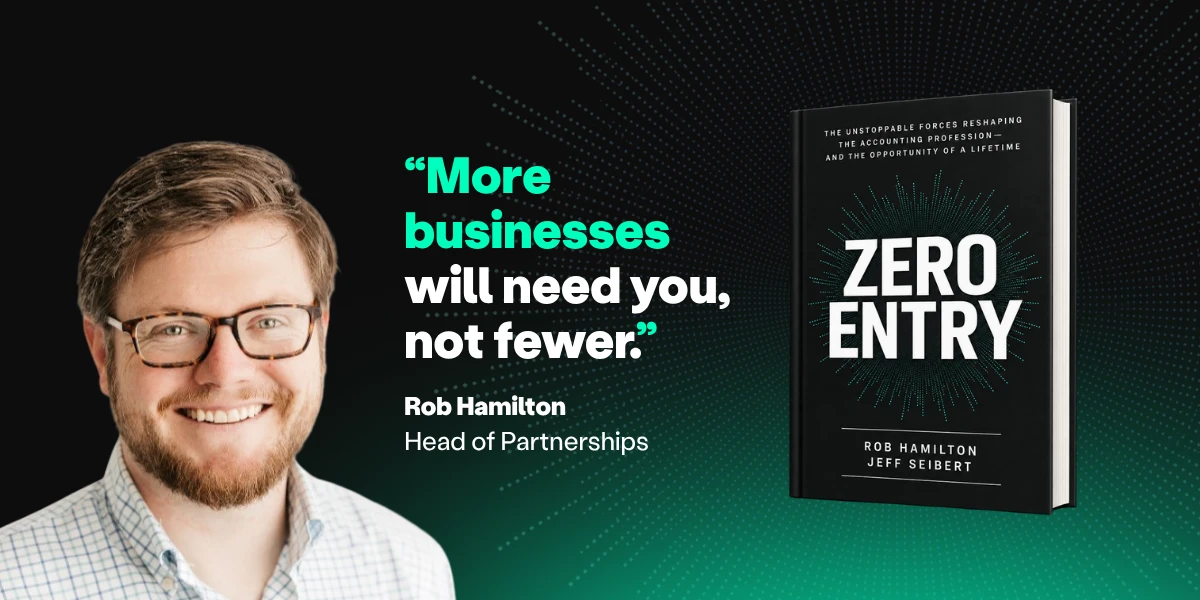
Zero Entry: The Opportunity of a Lifetime for Accountants

Jeff Seibert and I have spent the last eight years building Digits. In that time, we've spent thousands of hours talking with accounting firms about what they need from their software. Plenty of those conversations opened with a complaint about a specific tool or workflow, but as we dug deeper, the problem was always bigger than the tool. The software firms rely on has been failing them for years, long enough that the workarounds have stopped feeling like workarounds. They've become part of the job.
If that were the only problem, it would be manageable. Firms have absorbed bad software before. But it isn't the only problem. At the same time, firms are facing a shrinking talent pipeline, private equity consolidation, pricing compression, and consequential decisions about their technology architecture. Any one of these could be handled on its own. Together, they put the profession on the brink of real distress.
On a flight across the country with no Wi-Fi, I started writing down all of these themes that eventually became Zero Entry. We wrote this book to bring firms along the path we have been walking ourselves. We have watched AI tools go from interesting to genuinely useful in our own work over a short stretch of time, and that same shift is arriving quickly for accountants and the business owners they serve. Putting our thinking somewhere everyone can access felt important, so that firm owners have the full context when they decide what is right for their own firm.
Why this era is not like the last three
Firm owners have been told before that a technology change was the one that would change everything, and every time, they have handled each of those changes as they arrived just fine. From handwritten ledgers to desktop software, then desktop to the cloud. Not many industries retool that often while keeping the work accurate and the deadlines met.
The piece that makes this time different, and true, is that AI changes how the work gets done vs. where the work gets done. It categorizes, reconciles, researches unfamiliar vendors, runs quality control, and closes the books. Changes of that kind do not stop at the software. It runs downstream into how a firm is staffed, how engagements are priced, and what the economics need to look like to support the business over the long term. Those are big questions that firms will be forced to grapple with sooner than in any prior cycle. The good news is that what we believe comes out the other side is a more human profession than the one most firms are running today; it is just going to take facing some hard challenges head-on to get there.
1. The ledger sets the ceiling
The general ledger is the gravitational center of a practice. Every categorization, every reconciliation, every report flows out of it, which means its architecture is the core determining factor of the AI capability your firm will ever have access to. Most platforms in use today store a transaction as a row of text in a relational database designed more than twenty years ago. There is no semantic understanding in that, and no amount of AI layered on top of it creates any.
2. The opportunity is in the part that was always human
Verification, compliance, interpretation, and accountability. An AI can categorize a transaction, project a tax liability, and flag a risk. It cannot sign the return, carry E&O insurance, or sit across from a business owner and say it stands behind the numbers and will answer for them. That signature, your signature, is the product. As production work compresses, the scarce thing becomes the professional willing to attach their name to the outcome.
3. More businesses will need you, not fewer
Business owners now have real access to baseline accounting through general-purpose AI tools, and starting a company keeps getting easier. Business applications in the US reached 5.62 million in 2025, well above the 3.47 million annual average since 2005, and 2026 is running roughly 18% ahead of last year's pace (US Census Bureau, Business Formation Statistics).
A much larger pool of small businesses will have serviceable books for the first time, including the ones firms have historically turned away because cleanup made them uneconomical to serve. But having books and trusting them are separate things. A business owner's attention belongs on their business, which is exactly why they hire you. The demand of this influx will ultimately flow to whoever is positioned to serve it at scale.
So what does this mean for your firm?
At the end of the day, every firm sits at a different point on the adoption curve with a different client base and different constraints, and anyone selling you a universal roadmap has not talked to enough firms. What we wanted was to get leadership teams asking the right questions before the market answers them on their behalf.
If you are a firm owner and looking at where to start, there is a firm AI maturity assessment linked at the back of the book. It takes a firm leadership team about an hour, and it tends to produce a useful and slightly uncomfortable conversation about where the firm actually stands rather than how it describes itself.
Take the Firm AI Maturity Assessment →
Then move. Speed matters more in this cycle than in the last three, because the advantages compound. A firm running on architecture that learns gets better at serving clients every month it operates. A firm waiting for clarity is holding still against a reference point that keeps moving.
What we hope for the profession
The tedium disappearing is the best thing to happen to accounting in a generation, as long as firms use the room it opens instead of filling it back up with more of the same. Accountants got into this to help business owners run better companies. There is about to be considerably more room to do that, and considerably more business owners who need it.
Build the infrastructure now so your firm is in a position to take it.
The opportunity is here. Zero Entry explores what AI changes for accounting, and how firms can make the most of what comes next. Buy Zero Entry →
Want to see where your firm stands? Take the Firm AI Maturity Assessment →


Stay up to date with Digits
Unsubscribe anytime.