
Digits vs. Double
Which accounting platform is best for modern businesses & firms?
The pace of modern finance doesn't wait for rules, clicks, and month-end marathons.
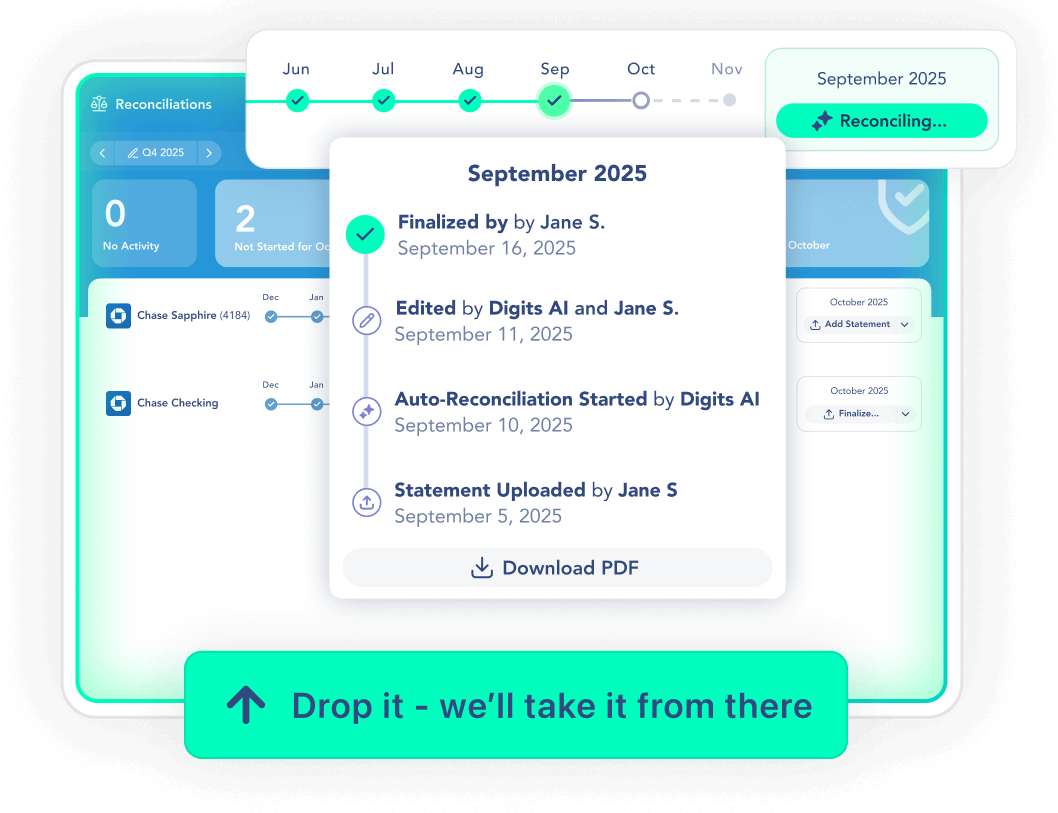
Digits is an AI-native accounting platform that reconciles to bank statements, runs continuous quality control checks, detects and drafts schedules, and unlocks unlimited collaboration—no rules, no scripts, no seat limits.
What we compare
Where AI actually does the work, who automates quality control and schedules, how teams collaborate, and what you'll really pay.
Digits Core $100/mo vs. Double Scale $50/mo + the cost of the underlying ledger
Features change—verify on vendor pages.

Built for AI, not before AI
Digits Core
Double Scale
Digits is the ledger and accounting system of record.
Not the ledger. An automation layer on top of QuickBooks Online, Xero, Sage, or NetSuite with a two-way sync. The connected ledger remains the system of record and a separate subscription.
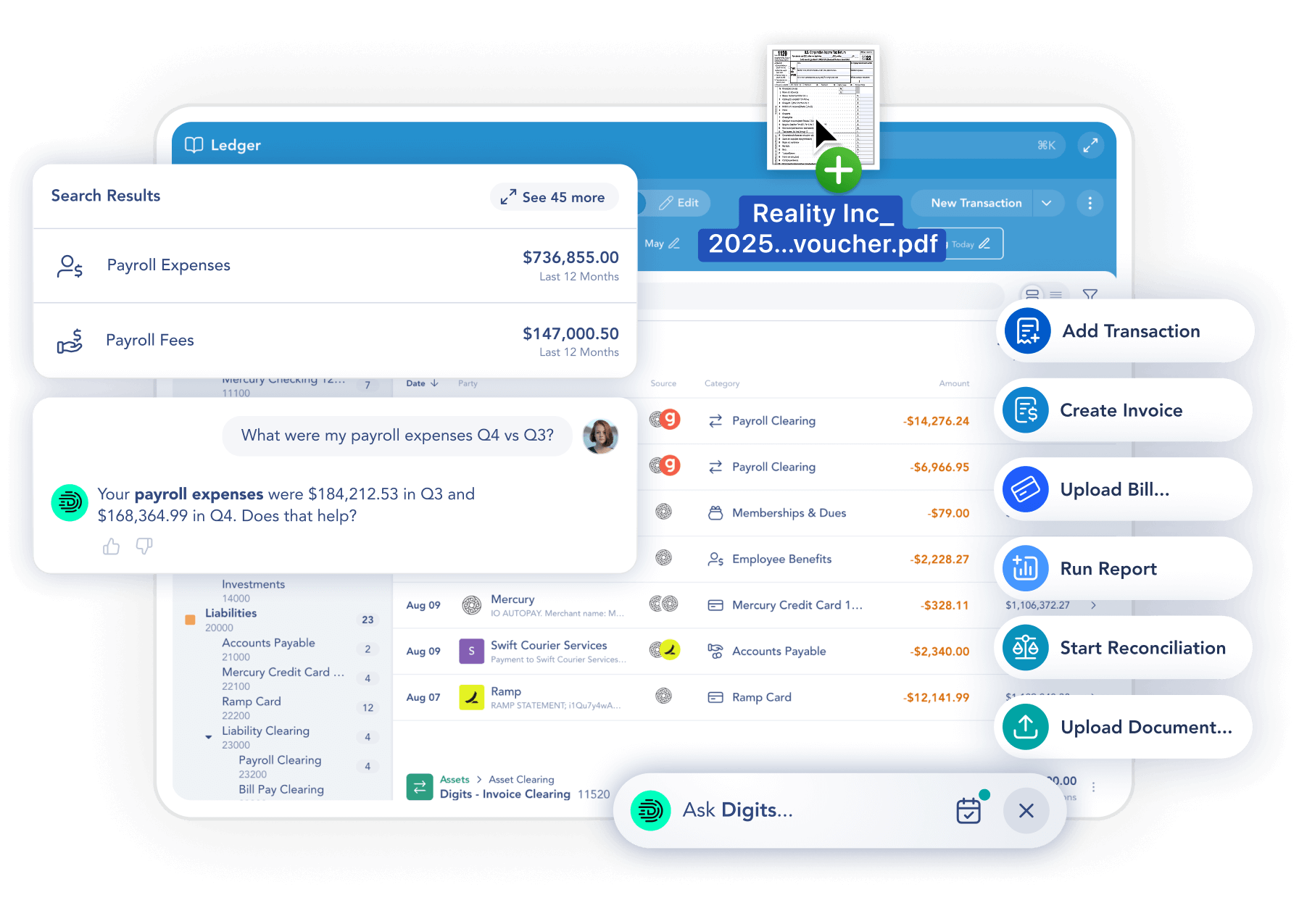
AI isn't a feature; it's the foundation. Digits is AI-native, powered by the Agentic General Ledger™ (AGL®). Proprietary models built for accounting and trained on 180 million real transactions representing nearly $1 trillion in financial activity auto-book, reconcile, and review continuously, then surface only the exceptions that need a human.
Uses third-party AI model providers — Anthropic, OpenAI, and Google — with data synced from the client’s existing accounting system. The AI works from synced ledger data, not from inside the ledger where the books are created, reconciled, and reviewed. Public docs do not disclose an accounting-specific model or benchmark methodology.
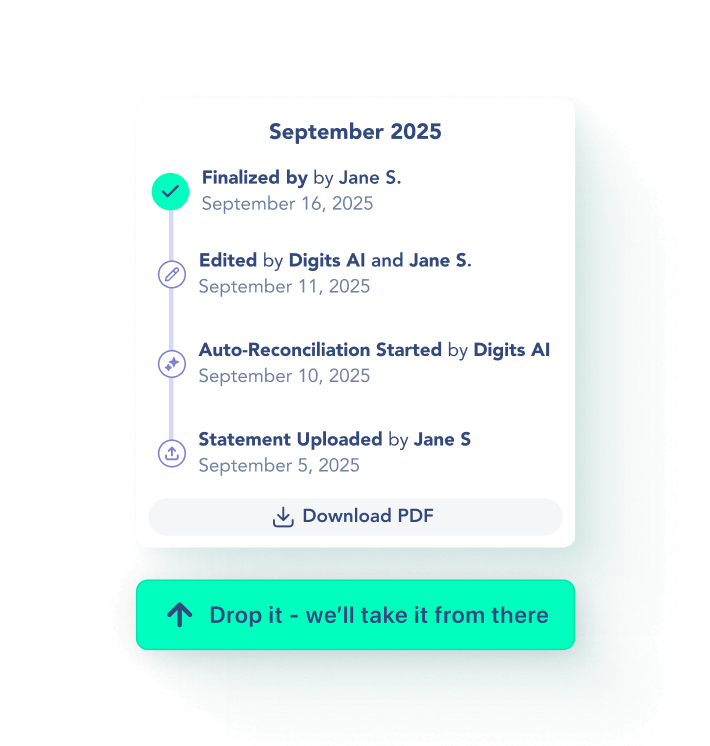
Digits automatically reconciles your accounts to bank statements (uploaded or connected) and flags only what needs review, so you can trust your numbers without doing the busywork. Reconciliation happens continuously, not just at month-end.
Reconciliation still happens in QuickBooks, with help from a Chrome extension. Can auto-clear transactions, analyze differences, and sync completed reports back.
Ask Digits is your ledger-native assistant, purpose-built for accounting. It understands your financial data and answers questions directly from the ledger. It is not a chat layer sitting on top of reports.
In-app AI chat for QuickBooks-connected clients only. Can query connected ledger data plus tasks, questions, documents, and workflow context.
AI does the routine work; you manage the exceptions. Exceptions and items flagged for review land in the Checklist, grouped by close step: uncategorized or low-confidence transactions, missing or duplicate items, schedule candidates, quality control flags, open comments, and more. With Digits Checklist, you review the close instead of preparing it.
Flags missing fields, uncategorized transactions, parent-account coding, missing attachments, inconsistencies, and duplicate entities. Review happens around the connected ledger.
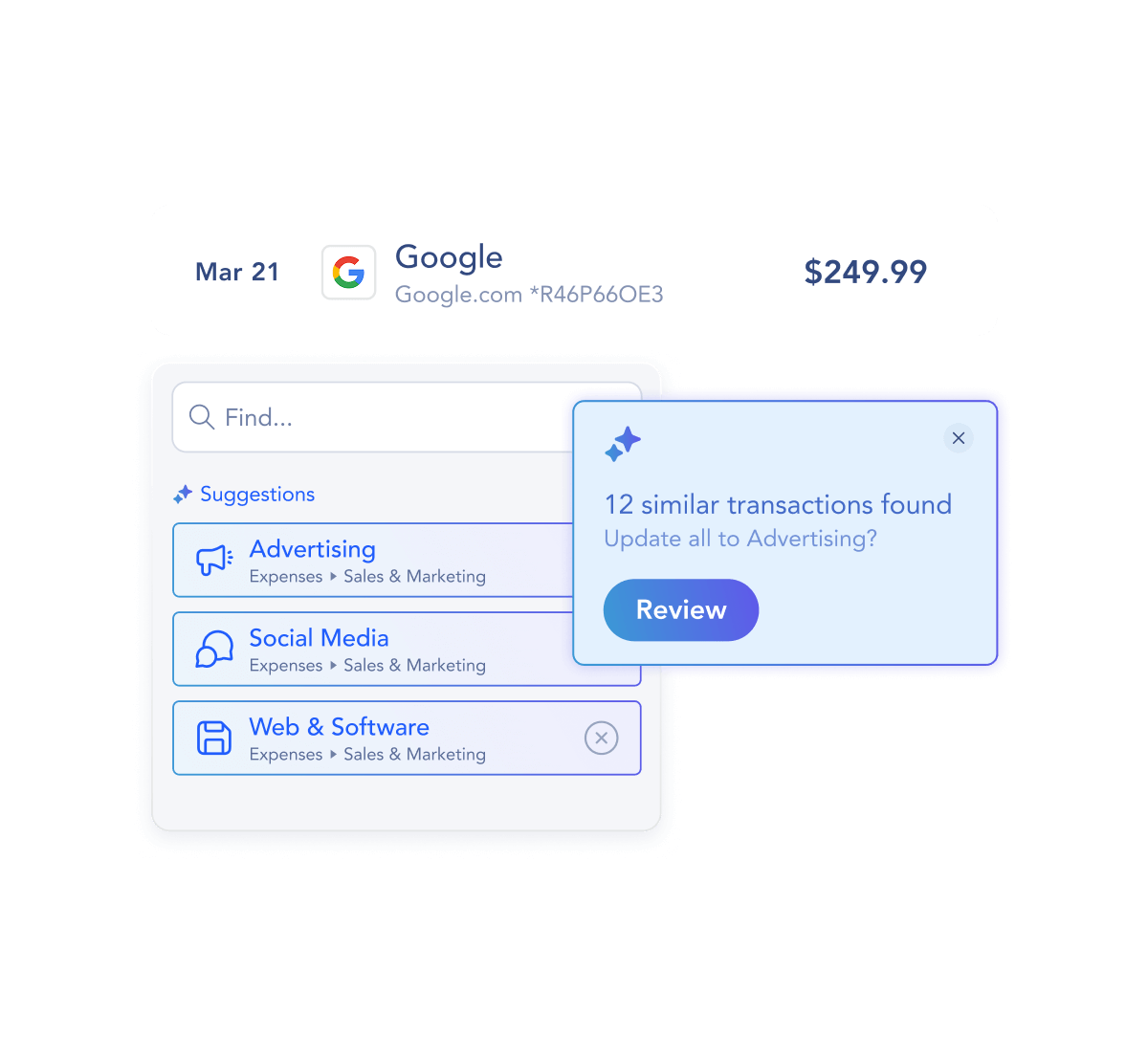
Describe a Quality Control check in plain English. Digits turns it into a deterministic check that runs the same way on every transaction, continuously. Built-in checks: missing fields, miscoding, duplicates, unusual activity, account validity, vendor changes, and more.
Custom checks are filter-based review reports you build for month-end. No automated logic across new, edited, and historical transactions.
Digits automatically detects and drafts schedules directly in the ledger. You can also create a new one or import a schedule. After accountant approval, Digits automatically generates recurring entries for prepaids and fixed assets.
Schedules are set up by hand or imported, then drafted for review and posted to the connected ledger. No detection of new candidates.
More than automation. Built for scale.
If you're comparing platforms to find the best AI accounting software, don't stop at task automation. Digits pairs the Agentic General Ledger™ with what real-world finance teams need: unlimited users, built-in comments, departments and locations, plus bill pay, invoicing, and documents in the same ledger.
Features & Limits beyond AI
Digits Core
Double Scale
Unlimited users included—firms, clients, CFOs, operators, auditors, all at no extra cost.
Unlimited users are included in Double, but the underlying ledger system/tool may still have its own user limits or fees.
Built‑in comments and @mentions on transactions, bills, categories, reconciliations and more. Checklist gathers every open question and action item in one place, by workflow step.
Provides workflow tools like client requests, reminders, inbox, email-linked tasks, time tracking, and team management. Collaboration sits around the connected ledger.
Visualize your business’s financial health. Real-time P&L, Balance Sheet, Cash Flow, and AR/AP Aging with drill-through to transactions and export. Drag-and-drop KPIs and statements as tiles.
Provides reports and close views, including P&L, Balance Sheet, Cash Flow, and aging reports. Reporting depends on connected ledger data.
Departments and Locations are included with dimensional dashboards and statement slicing. (Projects coming soon.)
Can review fields from the connected ledger, such as classes, locations, customers, vendors, and accounts.
12,000+ banks & cards via Plaid, plus Gusto, Ramp, BILL, Stripe, Mercury, and Reach Reporting; bank statements auto‑fetched to Documents for many institutions; PDF‑to‑CSV where supported.
Supports bank/card feeds for AI-assisted categorization, review, and posting to the connected ledger. Works from transactions already coded in the connected ledger; items still sitting in the QuickBooks or Xero bank feed must be classified or accepted in that system before they're visible in Double.
Read and write your ledger from AI tools. The Digits API and Digits MCP read from and write to the Digits ledger from AI tools like Claude, ChatGPT, Cursor, and Perplexity. Send raw transactions and Digits AGL® books, categorizes, and enriches them into clean entries, all governed by your existing Digits permissions.
Read-only MCP. No public API documented.
AI Bill Pay and AI Invoicing included—digitized documents, auto-extracted vendor data, smart categorization, and streamlined approvals.
Can generate and post bills, invoices, and related transactions to the connected ledger. AR/AP workflows remain in the underlying system.
One tool, no bolt-ons. Bill pay, invoicing, documents, and reconciliation run in the same system as your ledger.
Connects to QBO, Xero, Sage, NetSuite, and other ledgers to manage close, receipts, reports, client requests, and AI workflows. Strong for existing stacks, but still adds another system around the ledger.
Trusted by 7,000+ accountants and business owners

















This is a fundamentally unique experience for our clients, allowing our professionals to spend more time helping clients get value from their financial data and make informed business decisions. Even more so than before, we can provide business consulting services that move our clients forward.

Digits simplified everything on the financial side. What used to take me four hours a day now takes just 15–20 minutes.

Digits is INCREDIBLE! So intuitive, interactive, very easy to pickup and finally gives the right information beyond spreadsheets.

Digits combines a sleek dashboard with deep, nuanced insights — it's the perfect balance.

I don't spend time on accounting — and I love that.

Sleek interface, world-class support — I save hours every month at close.

Digits AI Invoicing makes managing my finances effortless. Everything's in one place—no more platform hopping.

The smoothest invoicing tool I've used. Everything just works, and billing takes a fraction of the time.

Digits saves 6 hours per client and helps us deliver deeper insights.

The future of accounting isn't crunching numbers — it's managing the tools that do. That's why I love Digits.

You don't have to sell me, the software sells itself.

A year in, my experience has been fantastic. Digits is the best AI-native accounting software available today — I’m so impressed that I only take on clients willing to use it.


Which Platform Is Right for You?

Digits Core
Is best for:
- Teams who want bookkeeping, reconciliation, and review in one system, with the books as the system of record
- Businesses that want custom, automated quality control checks that run the same way on every transaction, every period
- Operators who want the AI working inside the ledger it posts to, so the books and the review never drift apart
Double Scale
May be better for:
- Businesses that are comfortable with third-party AI providers working from synced ledger data
- Companies willing to add another system to manage close workflows around their existing books
- Teams that are fine reconciling in QuickBooks with a Chrome extension, rather than having statement-tied reconciliation run inside the ledger
Frequently asked questions
The main difference is that Digits is the ledger, while Double sits on top of another ledger, like QuickBooks, Xero, Sage, or NetSuite. Digits brings AI bookkeeping, reconciliation, reporting, automated schedules, and Quality Control into one accounting system. Double adds review, close, client workflow, and AI tools around an existing accounting system.
Double's AI features send data to third-party model providers, which Double's security documentation names as Anthropic, OpenAI, and Google, to flag coding errors, build schedules, and answer questions about data synced from the client's ledger.
Digits runs on the Agentic General Ledger™ (AGL®), a proprietary model architecture built specifically for accounting and trained on 180 million transactions representing nearly $1 trillion in real financial activity. In its 2026 benchmark, Digits AGL® achieved 97.8% transaction-categorization accuracy, scored against ground truth established by U.S.-based GAAP accountants. Double does not publish an accuracy benchmark.
Yes. Double isn't a ledger; it connects to QuickBooks Online, Xero, Sage, or NetSuite and works from the data in that system, which stays your system of record. The bank feed, reconciliation, and the books themselves live in the connected ledger, and Double adds review, close, and client-workflow tools around it. Digits is the ledger itself, so AI bookkeeping, reconciliation, reporting, and Quality Control all happen in one system — with nothing underneath it to maintain or pay for separately.