Will AI Replace Accountants? Why the Job Is Shifting, Not Disappearing

AI is not replacing accountants. It is replacing routine categorization, manual reconciliation, invoice matching, and month-end cleanup. These are tasks that consumed accounting team hours but rarely required professional judgment.
What remains is the work AI cannot do: applying professional judgment to exceptions, taking accountability for the numbers, interpreting financials for clients, and serving as the accountable professional behind the work.
AI does not make the accountant less important. It gives the accountant more time for the work that matters: review, advisory, interpretation, and judgment.
With AI, the accountant becomes the trust layer: no longer responsible for producing every line of the books by hand, but accountable for verifying the system’s work, resolving the exceptions, interpreting the numbers, and standing behind the financials.
That shift requires more than AI layered on top of accounting software. It requires a ledger that can do the routine work itself: categorize transactions, reconcile accounts, verify its own work, and surface the exceptions that need human judgment.
That is what Digits’ Agentic General Ledger™ is built to do. The ledger categorizes, reconciles, verifies, and posts routine transactions inside the system of record while applying the firm's standards, learning from prior treatments, and surfacing only the exceptions that need professional judgment. The accountant reviews those exceptions, advises the client, interprets the numbers, and takes responsibility for the result.
The question every accountant is asking
Every accountant is hearing the question now, from partners, staff, clients, candidates, and themselves. In a firm Slack thread: "What happens when AI can do the books?" In a partner meeting: "What happens to the firm if AI handles the work our juniors used to do?" From a senior associate: "What does my role become if the system handles the review queue?" From an accounting student: "Is this still a profession worth entering?"
The questions are fair because the change is no longer theoretical. AI categorizes transactions faster than a human. It reconciles bank feeds without getting tired. It can match invoices, flag exceptions, summarize activity, and keep routine work from piling up. AI is already absorbing work that never required professional judgment.
But categorization, reconciliation, cleanup, and receipt-chasing were always the work that made accounting possible, not the work that made accountants valuable.
The actual work is interpretation. Reading the numbers. Understanding the story they tell. Helping the business owner make a better decision as a result. The accountant sits between a business and its financial reality, translating one into the other.
The problem is that the necessary work expanded until it consumed the day, then the week, then the career. Nobody was doing bad work. The books had to be cleaned up. The transactions had to be categorized. The accounts had to be reconciled. But somewhere along the way, the tedium started to look like the job itself.
Will AI Replace Accountants?
No. AI is replacing the categorization, reconciliation, invoice matching, and cleanup work inside the accountant’s job — not the accountant.
The distinction matters because the accountant’s job has always included different levels of work. On one end: entering transactions, matching bank activity to invoices, and fixing client miscategorizations. On the other: deciding how to treat a complex transaction, advising a client on tax strategy, issuing or standing behind financial reports, and taking professional responsibility for the books.
AI does the first kind of work well. It cannot do the second kind. The CPA designation is one example of why this distinction matters: some accounting work requires licensed judgment, professional accountability, and someone who can stand behind the result. Even outside formal CPA sign-off, clients still need a qualified professional who understands the business and takes responsibility for the numbers.
An AI system can generate an output. It cannot serve as the responsible preparer, carry E&O insurance, respond to a regulator, or tell a client, “I reviewed this, and I stand behind it.”
With an agentic ledger, the ratio changes. The accountant spends less time producing the routine work and more time reviewing exceptions, advising clients, applying judgment, and taking responsibility for the result.
What parts of accounting can AI actually do?
AI can handle routine transaction work at scale when the intelligence lives inside the ledger itself. Not in a general-purpose model. Not in a bolt-on tool. Not in a workflow that still waits for a human to move the books forward.
Transaction categorization. AI can read a transaction in context, including vendor identity, prior treatments, firm standards, client history, and industry patterns, then post it to the right account on the right entity.
Transaction posting. When confidence is high and verification passes, AI can post routine transactions directly to the ledger instead of waiting for a human to approve every line.
Bank reconciliation. AI can match bank activity to ledger activity continuously, surfacing exceptions when something does not match. Reconciliation stops being only a month-end exercise and becomes part of a continuous close where the ledger stays current throughout the period.
Invoice and bill matching. AI can connect invoices to revenue, bills to expenses, and payments to records without requiring a human to move each match across systems.
Embedded verification. AI can check its own work before anything posts. In Digits, a separate verification layer reviews categorizations against the firm’s standards and prior treatments before the accountant sees the work.
Exception routing. AI can separate routine transactions from the smaller set that actually requires human judgment, then route those exceptions to the accountant.
This is where purpose-built accounting AI matters. Digits spent six years developing proprietary, domain-specific AI models for accounting. For core accounting workflows, Digits uses deterministic models designed to produce consistent, verifiable results rather than rely on a general-purpose LLM to generate a probable answer.
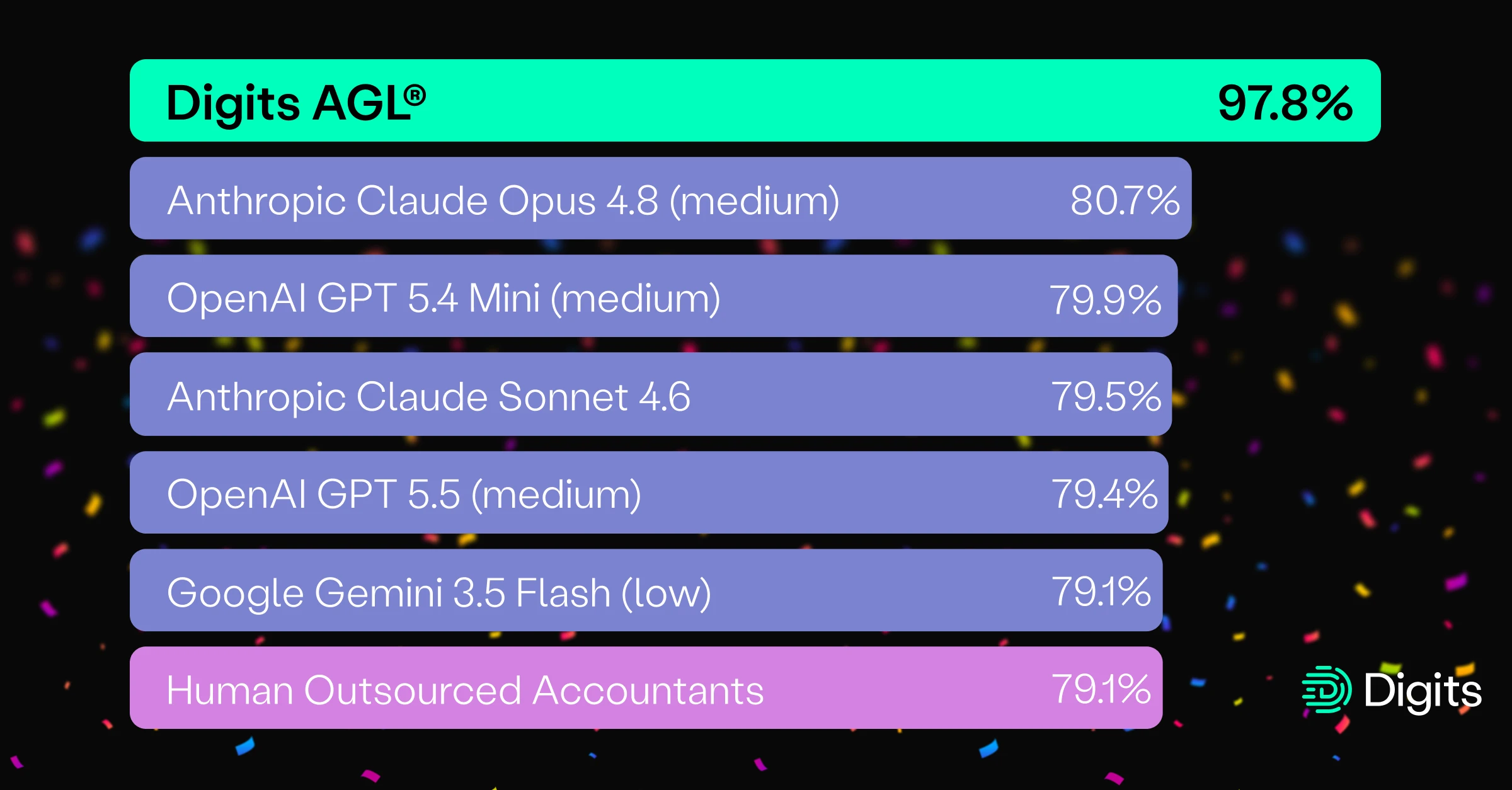
In its 2026 benchmark, Digits AGL® achieved 97.8% transaction-categorization accuracy using ground truth reviewed by U.S.-based GAAP accountants, outperforming every frontier AI model tested. The methodology and results are published in the whitepaper Beyond the AI Hype: Evaluating LLMs vs. Digits AGL for Accounting Tasks.
What parts of accounting still need a human?
The parts that require judgment, accountability, interpretation, and trust.
Judgment on complex transactions. Some accounting decisions do not have a clean rule or repeatable pattern. They require a professional to interpret the facts, apply the right standard, and decide what treatment the books should reflect. AI can surface context, but a human makes the judgment call.
Edge cases and exceptions. Not every exception is a complex accounting issue. Some are simply unfamiliar, incomplete, inconsistent, or high-risk. AI can surface those items, prioritize them, and provide context. The accountant decides whether the transaction follows an existing pattern, needs a new treatment, or should be escalated.
Client advisory. Accurate books tell the client what happened. Advisory tells them what to do next. AI can prepare more of the inputs, but the conversation still belongs to the accountant who understands the business, the context, and the consequences.
Accountability and the professional signature. The books still need an accountable professional behind them. When financial statements go to a lender, investor, board, or regulator, the name attached to them carries professional liability. AI can categorize a transaction, generate a tax projection, or flag a compliance risk. AI cannot sign the return, carry E&O insurance, respond to a regulator, or tell a client, “I reviewed this, and I stand behind it.”
Tax strategy and compliance. Federal and state tax law is complex, jurisdiction-specific, and constantly changing. AI can assist with research, drafting, and scenario analysis, but strategic tax decisions and compliance responsibility still sit with a qualified professional.
Trust and relationship. Clients trust the person who understands their business, explains the numbers, and takes responsibility for the result. AI can support that relationship, but it does not replace it.
How does the accountant’s role change when AI does the routine work?
The accountant moves from processing the books to reviewing, interpreting, and standing behind them.
In a traditional firm, the accountant is still responsible for moving the books forward: categorizing transactions, reconciling accounts, preparing financials, reviewing the work, and signing off. Even when software helps, the workflow still depends on humans to process, approve, and assemble most of the routine work.
When the ledger can handle the routine accounting work, that changes. Transactions are categorized, reconciled, verified, and routed as they arrive. The accountant reviews exceptions, applies judgment, interprets results, advises clients, and approves the work before it reaches the client.
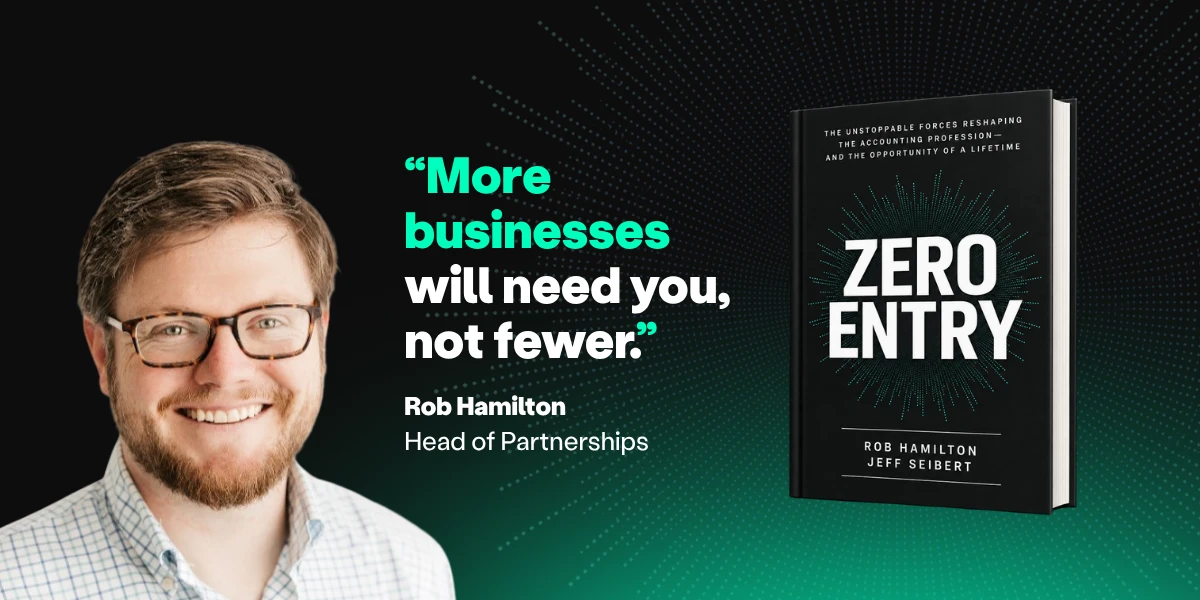
This shift is at the heart of Zero-Entry Accounting™, where financial entries can be created and maintained without being manually processed by a human accountant. It is also the idea behind Zero Entry, the book by Rob Hamilton and Jeff Seibert about how AI is reshaping the accounting profession and creating an opportunity for accountants to spend more time on judgment, advisory, and trust.
For mid-market and large firms running CAS at scale, the change is simple: growth stops depending on hiring at the same rate. As more routine work moves into the ledger, the same team can support more clients, spend more time on advisory and review, and protect margins without turning every new client into a hiring problem.
Why AI layered on top of legacy accounting software is not enough
The difference between AI that assists accountants and AI that changes the accounting workflow comes down to the ledger.
Legacy platforms like QuickBooks and Xero were built to store transactions, not understand them. They can hold the data, organize the chart of accounts, and record what happened. But the meaning of a transaction still has to be interpreted: what the vendor is, what the expense represents, which entity it belongs to, how the firm has treated similar transactions before, and whether the treatment fits the client’s books.
That is why AI features layered on top of legacy workflows often do not change the accountant’s role. They may suggest a categorization, flag an anomaly, or summarize activity, but the accountant still has to verify the output, approve the treatment, and make sure the ledger reflects the truth.
Digits is built differently. Vendors, customers, categories, and transactions exist as objects that the system can relate to each other, rather than isolated rows waiting for human review. That architecture is what allows the ledger to act directly: categorizing, verifying, posting, reconciling, and surfacing exceptions without waiting for a human to move every item forward.
When AI is bolted on top of legacy accounting software, the intelligence lives outside the ledger. It reads transactions from one system, interprets them in another, and then has to push the result back into the general ledger. Every handoff creates a place for systems to drift out of sync. A categorization may not post correctly. A reconciliation status may not carry over. An exception may be resolved in one tool but not reflected in the books.
That is truth drift: the gap between what an outside AI tool thinks happened and what the general ledger actually reflects.
Digits is ledger-native, so the intelligence operates directly inside the system of record instead of in a separate accounting layer that has to sync back to the ledger.
The role shift only happens when the ledger can do the work, not just suggest the work.
What is "the trust layer" in AI accounting?
The trust layer is the human function that makes AI-assisted accounting trustworthy.
When AI categorizes a transaction, reconciles an account, posts to the ledger, or contributes to financial reporting, the output still needs professional oversight. The client needs to trust the books. The lender needs to trust the statements. The board needs to trust the audit trail. AI does not vouch for itself. A qualified professional does.
That is why the accountant’s role becomes more important as AI does more of the routine work. The volume of work moving through the system increases, but the need for judgment, review, and accountability does not disappear. It concentrates.
Platforms can automate software-operator workflows. They can reduce manual categorization, reconciliation, and cleanup. But they cannot replace the professional judgment that clients, lenders, regulators, and business owners need someone to stand behind.
In Digits, embedded verification is the system-side counterpart to the human trust layer. The ledger checks its own work before it reaches the accountant. The accountant reviews the exceptions, interprets the results, and stands behind the financials before they reach the client.
Both layers matter. The system creates reliability. The accountant creates trust.
What does the role shift look like in practice?
Picture a CAS lead managing a portfolio of clients.
Under a manual or AI-enabled firm, she opens her day to a queue of transactions waiting for review. Some need categorization. Some need reconciliation. Some were suggested by software but still need approval. She spends the day accepting, correcting, matching, and preparing the books for review. The work gets done, but most of her time goes to moving routine items through the system.
With Digits’ Agentic General Ledger™, the accountant does not start with a transaction queue. They start with the exceptions. The routine work has already been categorized, reconciled, verified, and posted where the system is confident. What remains is the work that needs context, judgment, or client follow-up.
That changes the shape of the day. More time goes to reviewing exceptions, explaining results, advising clients, evaluating complex treatments, and preparing financials that are already closer to current.
Same accountant. Same clients. Different work.
What does this mean for accounting careers?
Accountants who adapt will spend more of their careers on higher-value work. Accountants who do not adapt will spend more time competing with AI on tasks AI is built to handle.
For partners: Firms that adopt an agentic ledger early can grow without turning every new client into a hiring problem. Margins improve. Advisory capacity expands. Hiring shifts from process-oriented bookkeeping roles to judgment-oriented accountants, CPAs, and advisors.
For seniors and managers: AI shifts more work to review, exception management, client advisory, and quality control. Instead of spending hours checking routine transactions, managers spend more time applying firm standards, coaching teams, interpreting results, and owning the client relationship. The high-value work shows up earlier, which can make the path to leadership more practical and more strategic.
For staff and associates: Instead of spending the first years buried in transaction processing, junior accountants start closer to the work that requires judgment: reviewing exceptions, supporting client communication, learning firm standards, and understanding why the system made each decision. The on-ramp gets steeper, but the work gets better.
For students considering accounting: the profession is becoming more interesting, not less. The work AI is best suited to handle is the work that used to dominate the early years: categorizing transactions, reconciling accounts, and cleaning up books. As that work moves into the system, the next generation of accountants can get closer to interpretation, advisory, accountability, and judgment earlier in their careers. The career does not get smaller. It gets closer to the work that made people choose accounting in the first place.
The profession is not shrinking. It is restructuring. The talent shortage is real, but firms with an agentic ledger can grow through it: serving more clients with the same team and shifting scarce talent toward advisory, review, and judgment.
Why AI can expand demand for accounting services
When routine accounting work becomes faster and cheaper to deliver, demand does not necessarily shrink. It can expand.
More businesses can afford clean books. More clients can access advisory. More firms can offer higher-frequency reporting, compliance monitoring, and strategic analysis without adding headcount at the same rate.
That is the Jevons Paradox applied to accounting: when something becomes more efficient, usage often increases because new use cases become economical. AI does not just reduce the cost of bookkeeping. It makes more financial insight possible for more clients, more often.
A small business that could not justify monthly advisory can now access it. A mid-market company that only received quarterly reviews can get more current insight. A firm that was capacity-constrained can serve more clients without making every new engagement a hiring problem.
But that demand only benefits firms structured to capture it. Firms with an agentic ledger can let the system handle the volume while their teams handle judgment, review, and advisory. Firms on legacy systems may see the opportunity expand while their people remain trapped in manual processing.
Where does Digits fit in the accountant's role shift?
Digits is the agentic ledger that moves routine accounting work into the system, so accountants can focus on judgment, review, advisory, and trust.
The Agentic General Ledger™ is built for accounting work to happen inside the ledger, not around it. It categorizes, reconciles, verifies, and posts transactions as they arrive, operating inside double-entry accounting rules and routing exceptions when human judgment is required.
That is what makes Zero-Touch Transactions™ possible. Over 96% of Digits transactions post without a human ever needing to touch them. They do not sit in a review queue waiting for approval. They are categorized, verified, and posted while the accountant focuses on the exceptions, the advisory conversation, and the professional sign-off.
Digits does this through tiered intelligence. Client-level models handle each business’s recurring patterns. Firm-level models encode the firm’s standards, conventions, and prior treatments across the portfolio. Global models provide broad accounting context. Fallback agents step in when a transaction is new, unclear, or low-confidence.
Embedded verification runs in parallel. A separate AI layer checks each categorization against the firm’s prior treatments before anything posts. Because the intelligence and the data live inside the same ledger, there is no truth drift to manage.
That matters for firms because the firm’s expertise becomes part of the system. Standards, judgment calls, client-specific treatments, and industry conventions are applied consistently across the portfolio instead of being trapped in handbooks, Slack threads, or senior reviewers’ heads.
The proof is published. In its 2026 benchmark, Digits AGL® achieved 97.8% transaction-categorization accuracy using ground truth reviewed by U.S.-based GAAP accountants, outperforming every frontier AI model tested. The methodology and results are published in the whitepaper Beyond the AI Hype: Evaluating LLMs vs. Digits AGL for Accounting Tasks.
One of the clearest places this role shift shows up is in continuous close: when routine categorization, reconciliation, verification, and posting happen throughout the month, the close becomes review and sign-off instead of cleanup.
For accountants using Digits, the role shift is practical. The ledger maintains the routine flow of accounting work: categorizing, verifying, posting, reconciling, applying firm standards, and routing exceptions. The accountant handles the work that still requires judgment, interpretation, advisory, and accountability.
Traditional workflow vs. agentic ledger
What changes | Traditional workflow | With an agentic ledger |
Routine work | Accountants categorize, reconcile, and clean up most transactions manually | The ledger categorizes, verifies, posts, and reconciles routine transactions |
Review | Accountants review broad transaction queues | Accountants review exceptions that need context or judgment |
Advisory | Advisory is often squeezed behind cleanup work | More time shifts to interpretation, advisory, and client-facing work |
Firm capacity | Growth often requires more headcount as client volume increases | Firms can support more work without hiring at the same rate |
Knowledge retention | Firm expertise lives in senior reviewers’ heads and repeated workflows | Firm standards and prior treatments are encoded into the system |
When should firms move to an agentic ledger?
Adapt early if:
Your firm is growing, but capacity is the constraint. Every new client should not require proportional headcount growth.
Your senior accountants, reviewers, and advisors are spending too much time on work that does not require senior judgment.
Your clients are asking for advisory, faster reporting, or more current financial insight, but routine bookkeeping is consuming the hours needed to deliver it.
Your firm’s standards, judgment calls, and client-specific treatments live in senior reviewers’ heads instead of inside a system that can apply them consistently.
Your team is already using AI tools, but still has to verify whether the AI’s output made it into the ledger correctly.
Stay where you are if:
Your firm is small, stable, and the current manual workflow is manageable.
Your clients are satisfied with historical reporting and are not asking for more current numbers, advisory, or higher-frequency insight.
Your team is not ready to change review workflows, firm standards, or how work moves through the ledger.
Your current bottleneck is not transaction volume, staffing capacity, reporting speed, or advisory demand.
The right timing depends on the firm. But the direction is clear: as routine work moves into the ledger, the firms that adapt first get more time for the work clients value most — review, advisory, interpretation, and judgment.
So, will AI replace accountants?
No. AI will replace the routine work that kept accountants from spending enough time on review, advisory, interpretation, and judgment.
That is a good thing for the profession. When categorization, reconciliation, cleanup, and transaction review move into the ledger, accountants do not become less important. They become more focused on the work clients actually value: explaining the numbers, resolving the exceptions, advising the business, and standing behind the result.
For firms, the shift is not just faster bookkeeping. It is a different operating model. The ledger maintains the routine flow of accounting work: categorizing, verifying, posting, reconciling, applying firm standards, and routing exceptions. The accountant handles judgment, interpretation, advisory, and accountability.
The firms that adapt will not just do the same work faster. They will serve more clients, protect margins, preserve firm knowledge, and give their teams more time for the work that requires judgment.
The profession is not getting smaller. It is becoming more valuable.
Frequently Asked Questions
Will AI replace accountants?
No. AI is replacing routine categorization, reconciliation, invoice matching, cleanup, and transaction review inside the accountant’s job, not the accountant. Accountants are still needed for judgment, accountability, advisory, interpretation, and professional sign-off.
What parts of accounting can AI actually do?
AI can handle routine transaction work at scale: categorizing transactions, posting high-confidence entries, matching invoices and bills, reconciling activity, verifying its own work, and routing exceptions for human review. Under Digits' Agentic General Ledger™ (AGL®), over 96% of transactions post without a human ever needing to touch them.
What parts of accounting still need a human?
The parts that require judgment, accountability, interpretation, and trust. Complex transactions, edge cases, client advisory, tax strategy, professional sign-off, and relationship-based guidance still require a qualified professional who understands the business and can stand behind the result.
What is "the trust layer" in AI accounting?
The trust layer is the accountable professional who reviews the work, resolves exceptions, interprets the numbers, and stands behind the result. In some engagements, that may be a licensed CPA. In others, it may be the accountant, advisor, controller, or firm leader responsible for the client relationship.
What is the Agentic General Ledger™?
The Agentic General Ledger™ is Digits' accounting system that categorizes transactions, reconciles accounts, verifies its own output, and keeps financials current continuously, without waiting for manual input at each step.
It uses Tiered Intelligence, organized through Digits’ Model Layer Cake: client-level models for recurring patterns, firm-level models that encode the firm's expertise across the portfolio, global models that provide broad accounting context, and fallback agents that research novel or unclear items.
Digits’ proprietary accounting models were trained on 180 million transactions representing nearly $1 trillion in real financial activity.
How accurate is Digits' AI?
In its 2026 benchmark, Digits AGL® achieved 97.8% transaction-categorization accuracy using ground truth reviewed by U.S.-based GAAP accountants, outperforming every frontier AI model tested.
The methodology and results are published in the whitepaper Beyond the AI Hype: Evaluating LLMs vs. Digits AGL for Accounting Tasks.
Is accounting still a good career in 2026?
Yes, and arguably more so than before. The work that used to consume the first few years of an accountant's career is now automated. The judgment, advisory, and accountability work that people actually wanted to do when they went into accounting starts sooner. The profession is restructuring, not shrinking.
How does the accountant’s role change with an agentic ledger?
The accountant moves from processing routine transactions to reviewing exceptions, advising clients, interpreting results, and standing behind the financials. With agentic AI, time previously spent on categorization and reconciliation shifts to exception resolution, client advisory, and senior review.
What is truth drift in accounting software?
Truth drift is the gradual divergence between what third-party tools think happened and what the general ledger actually reflects. It occurs when intelligence lives outside the ledger in bolt-on categorization tools, separate reconciliation apps, or third-party AI layers. Every handoff between systems introduces a seam where data can fall out of sync. In a real-time system like Digits, where the intelligence lives inside the ledger, truth drift disappears: there is no handoff, no sync lag, and no second system to verify against.
What is CAS or CAAS accounting?
CAS (Client Accounting Services) and CAAS (Client Accounting and Advisory Services) refer to accounting firms that provide ongoing financial management and advisory support beyond compliance work. Real-time bookkeeping is especially valuable for CAS and CAAS firms because advisory conversations depend on current financial data — not historical reporting from last month's close. Digits is built for CAS workflows, with firm-level intelligence that compounds across the client portfolio and continuous ledger updates that keep advisory-ready data available at all times.
Will accounting firms lay off accountants because of AI?
Most growing firms will not. The capacity AI frees up gets reinvested in advisory services and additional clients. The Jevons Paradox suggests demand for financial services will expand, not contract, as delivery becomes faster and cheaper. The firms that struggle are those whose business model depended entirely on work AI now does, and that did not invest in the advisory and trust work that replaces it.
Does AI accounting change the value of the CPA designation?
It can make the CPA’s judgment and accountability even more valuable. As AI handles more underlying processing, clients, lenders, boards, and regulators still need qualified professionals to review results, apply professional standards, and stand behind the work.
How does Digits support the accountant's role shift?
Digits is the system that does the routine work so the accountant can do the judgment work.
The Agentic General Ledger™ categorizes, reconciles, and verifies transactions continuously.
Tiered intelligence and embedded verification let over 96% of transactions post without a human ever needing to touch them. The firm's expertise is encoded into the system and compounds with every close. The accountant becomes the trust layer for the exceptions and the financial statements that result.
See what this looks like today! Team Digits represents a collective voice behind Digits' content across blog articles, podcast episodes, research, and product storytelling. Spanning leaders across product, marketing, customer experience, and operations, the team brings together diverse perspectives to explore the future of AI-native accounting and modern finance.
From in-depth explainers and industry insights to company updates and conversations with founders, Team Digits shares the ideas, stories, and expertise shaping how businesses and accounting firms manage their finances in the AI era.


Stay up to date with Digits
Unsubscribe anytime.