What Is Continuous Close? How AI Ends the Month-End Cleanup Sprint

Continuous close is an accounting workflow where the ledger categorizes, reconciles, and verifies transactions the moment they arrive. The books stay current throughout the month instead of being cleaned up at month-end.
The accountant’s role shift shows up most clearly in the close. When the ledger handles routine categorization, reconciliation, verification, and posting throughout the month, accountants spend less time assembling the books and more time reviewing, interpreting, and advising.
This requires more than an AI-native label. It requires agentic accounting software: a system that executes accounting work continuously inside the ledger itself, categorizing, reconciling, verifying, and posting transactions as they arrive instead of waiting for month-end review.
During a traditional month-end close, legacy accounting systems accumulate unfinished work throughout the period. Transactions remain uncategorized, reconciliations wait until month-end, and accounting teams spend days bringing the books current.
Bolt-on AI can make parts of the close faster, but it cannot deliver a true continuous close. The architecture still depends on humans to move work through disconnected systems, and the backlog compounds until month-end.
Digits delivers continuous close through the Agentic General Ledger™, powered by proprietary accounting models trained on 180 million transactions representing nearly $1 trillion in real financial activity.
For businesses, accounting firms, and finance teams using Digits, month-end is no longer a bottleneck.
Why traditional month-end close creates a cleanup sprint
Every accounting firm knows the rhythm. The first business day of the month opens. Bank feeds finish syncing. The team starts the close. Categorizations get cleaned up, accruals get booked, reconciliations get matched, exceptions get worked, and around day four or five, the partner signs off on the draft financials before they go out to clients.
Legacy accounting systems store transactions as rows of raw data in relational tables. The system cannot determine on its own what kind of expense a transaction represents, which entity it belongs to, or what the right accounting treatment should be. That work still depends on human review and interpretation.
A general ledger built this way accumulates unfinished accounting work throughout the period instead of keeping the books continuously current. Month-end becomes the process of catching the ledger up in a sprint.
That architecture made sense in 1995. Computers could not categorize transactions in context. AI could not read merchant strings and infer accounting treatment. The close ritual was the necessary workaround.
In 2026, the architecture has changed, but the workflow often has not. Most firms still use legacy ledgers like QuickBooks and Xero because those systems were designed around periodic close. They include AI features that suggest categorizations and flag anomalies, but the firm still maintains the books throughout the period and reconciles everything at the end.
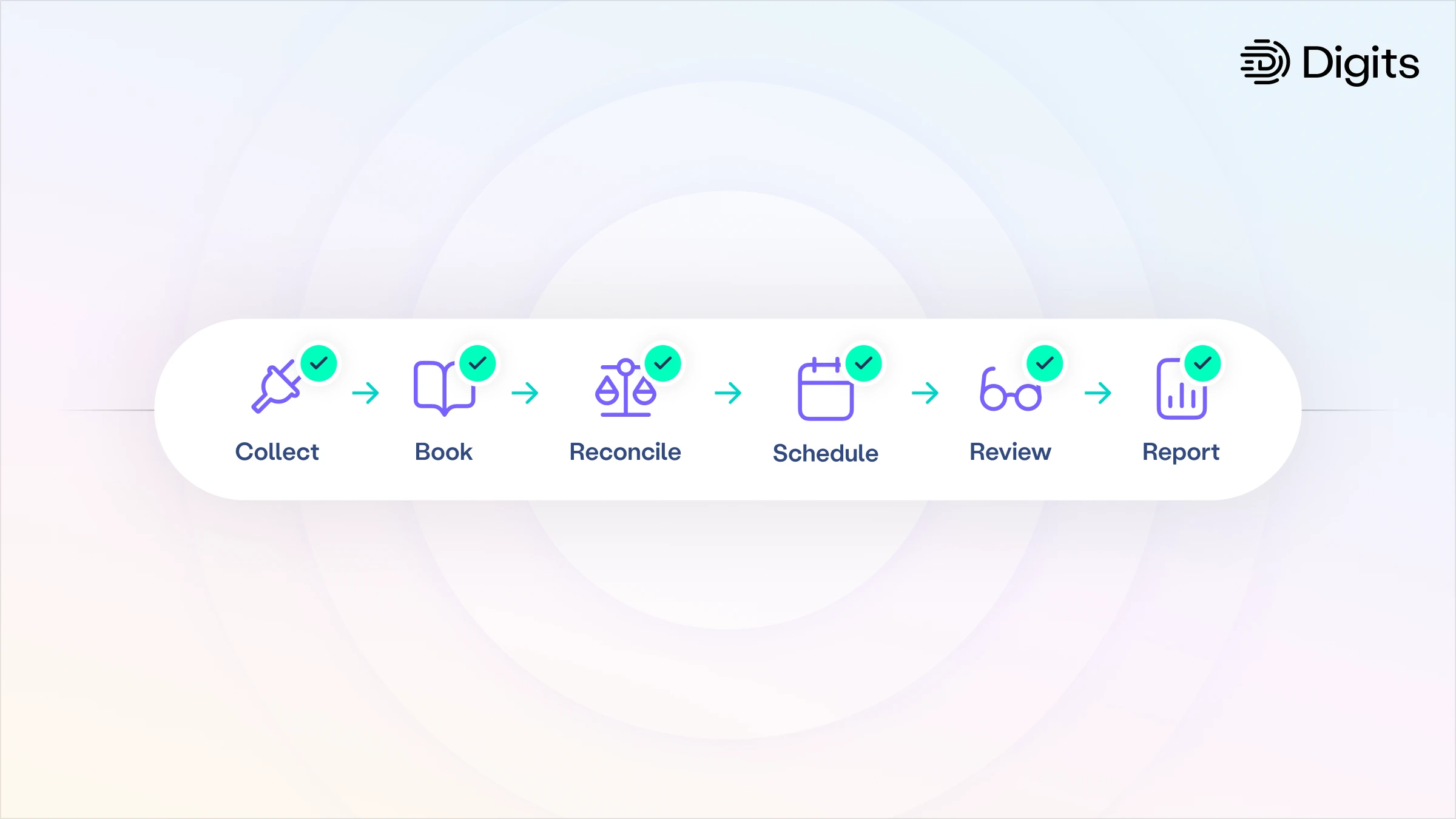
Continuous close changes the cadence entirely. Instead of letting work accumulate, the ledger categorizes transactions as they land, runs reconciliations continuously, and verifies treatments before anything posts. Exceptions surface immediately instead of weeks later during cleanup.
This requires an agentic ledger: one that continuously executes accounting work inside the system of record itself, not AI layered on top of a legacy workflow.
By the time month-end arrives, there is far less to assemble. The exception queue is smaller and prioritized. The financials are already closer to current. Partners review, teams handle exceptions, and firms can move toward reports going out on day one instead of day five.
How does continuous close work?
Continuous categorization
Every transaction that lands gets categorized in real time instead of accumulating in the ledger to be sorted later. The system evaluates the transaction in context: vendor identity, historical treatments, firm standards, entity structure, and industry patterns. Then it posts the transaction to the correct account on the correct entity automatically.
Continuous reconciliation
Bank feeds, payroll activity, payment processors, vendor bills, and ledger activity reconcile continuously as new data arrives. Reconciliation stops being a once-a-month process of comparing disconnected records. It becomes a continuously maintained state.
When something does not match, the exception surfaces immediately while the context is still fresh, instead of weeks later during the close.
Continuous verification
A separate AI layer reviews each categorization for consistency with the firm's standards and historical treatments before anything posts. If the system is not confident, the transaction routes to the exception queue for human judgment. If it is confident, the transaction posts automatically.
Verification is what makes continuous categorization safe to trust.
When categorization, reconciliation, and verification all run continuously, the books stay current. The close becomes review and sign-off instead of assembly.
This is also why bolt-on AI tools cannot deliver a true continuous close. When categorization and reconciliation happen outside the ledger in third-party tools connected through APIs, the accounting workflow gets split across multiple systems.
The AI may categorize a transaction correctly, but the firm still has to verify that the categorization synced properly into the general ledger, posted to the correct entity, and stayed consistent across reconciliations and reporting. Every handoff creates another opportunity for systems to drift out of sync.
That is truth drift. Instead of eliminating month-end review work, firms end up reviewing whether the AI's output actually made it into the books correctly.
Continuous close only works when the intelligence is ledger-native, operating directly inside the system of record where categorization, reconciliation, verification, and posting happen in the same ledger.
What is the difference between a continuous close and a fast month-end close?
A fast month-end close is still a month-end close. Continuous close removes the catch-up process entirely.
This distinction matters because most "AI close" tools sold today are fast-close tools, not continuous-close tools. They help firms categorize transactions faster, identify exceptions earlier, and reconcile accounts more efficiently, but the accounting work still concentrates around month-end.
Under a fast-close workflow, transactions continue accumulating throughout the period, and the firm resolves the backlog during the close window. The cleanup sprint may shrink from five days to two, but the sprint still exists.
Continuous close changes the accounting model itself. Transactions are categorized, reconciled, verified, and posted continuously as they arrive, so unfinished work does not accumulate across the month. By the time month-end arrives, the books are already current.
Legacy platforms, and even some newer ones, now market faster month-end workflows as continuous close without changing the underlying ledger architecture. But legacy ledgers were designed around periodic catch-up work. Transactions accumulate throughout the month, reconciliations happen in batches, and firms still have to bring the books current at the end of the period.
AI can accelerate that process. It cannot fundamentally eliminate it unless the ledger itself is rebuilt for continuous accounting.
For the client
A SaaS client's Stripe payout hits the bank account at 2 pm on a Tuesday. Everything that happens next depends on the ledger.
Under a traditional month-end workflow, the transaction lands in the bank feed and waits for the firm's team to review it during the next close cycle. Until then, the client's books reflect the cash movement, but not the correct revenue treatment. The reporting the client would want to see today does not exist yet.
Under continuous close, the ledger processes the transaction immediately. Where the supporting context is available, the system applies the appropriate revenue treatment, reconciles the activity, and posts it to the correct account and entity after verification passes.
Within minutes, the books are closer to current. The client can see financials based on activity that has already been categorized, reconciled, verified, and posted, rather than waiting days after month-end closes.
For the accounting firm
Now multiply that across thousands of transactions each month across dozens of clients. The operational difference compounds quickly.
Under a traditional close, the first week of the month becomes a catch-up cycle. Partners walk into queues of client engagements that still need reconciliations completed, categorizations reviewed, accruals booked, exceptions resolved, and draft financials prepared. Teams spend days bringing the books current before reports finally go out to clients.
Under continuous close, that backlog largely disappears. Reconciliations already ran throughout the period as transactions arrived. Exceptions surfaced when they occurred. Draft financials are already waiting in the partner's review queue.
The first week of the month shifts from cleanup to advisory.
Where does Digits fit in a firm's stack for continuous close?
Digits replaces the general ledger. It is not a categorization plugin layered onto QuickBooks, and it is not a close-acceleration tool running alongside an existing ledger. It is the system of record where accounting work happens, built from the ground up to keep books continuously current.
That position in the stack makes continuous close structurally possible. Digits is ledger-native, so the intelligence operates directly inside the general ledger rather than being bolted onto it. Transactions do not have to sync between a separate AI accounting layer and the system of record. Reconciliations do not have to be verified across those two systems, reducing the risk of truth drift.
The exception queue surfaces only the work that actually requires human judgment, because routine accounting work is already completed as transactions arrive.
For firms running CAS, that changes what the team spends time on. Less cleanup. More advisory.
How does Digits enable continuous close?
Digits is built on the Agentic General Ledger™ (AGL®), an AI-native ledger trained on 180 million transactions representing nearly $1 trillion in real financial activity, and it operates continuously by design. The system does not just assist the close workflow. It keeps the books current by categorizing, reconciling, verifying, and posting transactions as they arrive across every client in the firm's portfolio.
The AGL® uses tiered intelligence, organized through Digits' Model Layer Cake. Client-level models learn the recurring patterns of each business. Firm-level models encode the firm's conventions, judgment calls, and quality standards across the portfolio. Global models provide broad accounting context across millions of historical transactions.
When the system encounters something unfamiliar or low-confidence, fallback agents step in to investigate the transaction directly, research vendors, gather supporting context, and classify it using guardrails before anything posts.
Each layer catches what the previous one missed. The intelligence compounds over time.
Digits uses purpose-built deterministic accounting models throughout core accounting workflows, where consistent and verifiable outputs matter.
Embedded verification runs continuously in parallel. A separate AI layer checks every categorization against the firm's historical treatments and accounting standards before it posts to the ledger.
Because the AI executing the work and the AI verifying the work operate inside the same system of record, there is no truth drift: no sync lag, no disconnected systems, and no second ledger to reconcile against.
The system's performance has been benchmarked on real business transactions.
In its 2026 benchmark, Digits AGL® achieved 97.8% transaction-categorization accuracy, scored against ground truth established by U.S.-based GAAP accountants, outperforming every frontier AI model tested.
The methodology, transaction composition, and reviewer credentials are documented in the whitepaper Beyond the AI Hype: Evaluating LLMs vs. Digits AGL for Accounting Tasks.
For accounting firms, the practical result is what continuous close is designed to deliver: books that stay continuously current, exceptions surfaced as they happen instead of in month-end backlogs, and a close window that becomes review, exceptions, and sign-off instead of cleanup.
Month-end close vs. continuous close
Process | Month-end close | Continuous close |
Categorization timing | Deferred until month-end | Processed as transactions arrive |
Reconciliation timing | Performed during close | Running continuously |
Verification | Reviewed during close by accountants | Continuous embedded verification |
Close window | 3–5 business days | Review and sign-off only |
Exception handling | Discovered during cleanup | Surfaced in real time |
Reporting freshness | Delayed until the close completes | Continuously current |
Truth drift risk | Higher across disconnected tools | Eliminated inside the ledger |
Knowledge retention | Firm standards live in reviewer workflows | Firm standards encoded into the system |
Capacity scaling | Scales with transaction volume | Scales with exception and judgment work |
Accuracy transparency | Limited published benchmarking | Published accuracy benchmark, with methodology |
Required architecture | Legacy ledger with AI add-ons (QuickBooks, Xero) | Agentic ledger with embedded verification (Digits) |
Why continuous close matters for accounting firms
The shift from a monthly close to a continuous close changes how accounting firms operate.
Capacity expands without the same headcount growth
Under a traditional month-end workflow, every new client adds a proportional amount of catch-up work. More transactions create more reconciliation, more categorization review, more cleanup, and more close pressure.
Continuous close changes that equation. Because categorization, reconciliation, and verification happen throughout the period, firms spend less time assembling books at month-end and more time handling exceptions and advisory work. Capacity scales more with judgment work than raw transaction volume.
Reporting moves closer to real time
Under monthly close, clients often wait until the fifth or tenth of the month for finalized financials. By the time reporting arrives, the numbers are already historical.
Continuous close shortens that delay dramatically. Firms can review current books earlier, deliver financials faster, and hold advisory conversations based on current operating conditions instead of month-old data.
Cognitive load decreases
Month-end close concentrates unresolved work into a short period of intense context-switching. Teams spend days reconstructing decisions across hundreds or thousands of transactions after the fact.
Continuous close distributes that work throughout the month. Exceptions surface closer to the moment the transaction occurs, when context is still fresh and easier to evaluate.
Firm knowledge compounds instead of walking out the door
In traditional accounting workflows, much of the firm's expertise lives in senior reviewers' heads: how specific clients are handled, how edge cases are treated, and what standards the firm applies repeatedly across the portfolio.
Continuous close systems encode those patterns directly into the ledger through firm-level intelligence and verification. New team members inherit the firm's standards from day one instead of learning them slowly through repeated review cycles.
That shift matters as firms face sustained staffing pressure and senior talent becomes harder to replace. When experienced reviewers leave, they take years of client context, judgment calls, and institutional memory with them. Firm-built software should preserve that expertise inside the system, so the firm’s standards survive turnover and scale across the portfolio.
On legacy systems, institutional knowledge leaves with the people who carried it. Under continuous close, that knowledge compounds inside the system over time.
Choose continuous close if:
Your firm is growing and capacity is the bottleneck
Your clients are asking for current numbers instead of month-old reporting
Your team is burning out on the month-end cleanup sprint
You want intelligence that compounds across the portfolio over time
You evaluate platforms based on published benchmarks instead of marketing claims
Stay with the traditional month-end close if:
Your firm has fewer than five clients, and the periodic catch-up is manageable
Your clients are not asking for current reporting
Monthly reporting cadence still matches the operational needs of your client base
Why month-end close becomes review, not cleanup
Month-end close is not a permanent feature of accounting. It is a consequence of how legacy ledgers were designed.
For decades, accounting systems accumulated unfinished work throughout the period and concentrated that work into a monthly cleanup cycle. The workflow existed because the architecture required it.
Continuous close changes the architecture underneath the workflow. Categorization, reconciliation, verification, and posting happen continuously inside the ledger itself, so the books stop falling behind in the first place.
The result is not a faster month-end close. It is a different accounting cadence entirely. The ledger maintains routine accounting work continuously, and accountants focus on the judgment that actually requires a professional.
Frequently asked questions
What is continuous close?
Continuous close is an accounting workflow where the books are kept current every day of the period, instead of being reconciled and closed in a sprint at month-end. The general ledger ingests, categorizes, reconciles, and verifies transactions as they arrive. The close window becomes review and sign-off, not assembly.
What is the difference between continuous close and continuous accounting?
The terms are often used interchangeably. Continuous accounting is the broader concept: accounting work happening continuously instead of in periodic batches. Continuous close is the operational result, where the books stay current throughout the period and the month-end catch-up process largely disappears.
Is continuous close the same as real-time close?
They are closely related, but continuous close is the more precise accounting term. “Real-time close” emphasizes speed. “Continuous close” emphasizes the workflow: books are maintained throughout the period so month-end becomes review instead of cleanup.
What is the difference between a continuous close and a fast month-end close?
A fast month-end close still does the close, just faster. Continuous close eliminates the cleanup sprint entirely because the books are already current when the period ends. Fast close compresses the cleanup window. Continuous close removes it. The test is whether the system maintains books continuously by acting on transactions as they arrive, or whether it makes the month-end sprint shorter.
Why does QuickBooks not support continuous close?
QuickBooks was designed around periodic close. It stores transactions as text rows that require human interpretation, and its AI features suggest categorizations rather than acting on them. Continuous close requires a system that maintains books in real time by executing the work — not one that helps a human do so faster.
Can a legacy accounting platform with AI features do continuous close?
The architecture limits how far it can go. Rules and suggestions speed up cleanup, but they do not eliminate it. When AI sits on top of a legacy ledger rather than inside it, the firm also inherits truth drift — the ongoing cost of verifying that the AI's outputs match what the ledger actually reflects. Continuous close requires an agentic ledger built on an AI-native architecture that categorizes, reconciles, and verifies transactions as they arrive, with the intelligence residing within the system of record.
What is truth drift in accounting software?
Truth drift is the gradual divergence between what third-party tools think happened and what the general ledger actually reflects. It occurs when intelligence lives outside the ledger in bolt-on categorization tools, separate reconciliation apps, or third-party AI layers, and every handoff introduces a seam where data falls out of sync. Truth drift makes continuous close structurally impossible because the firm cannot trust that the books are current if the systems disagree. When intelligence lives inside the ledger, truth drift is eliminated.
What is the Agentic General Ledger™?
The Agentic General Ledger™ is Digits’ accounting system that categorizes transactions, reconciles accounts, verifies its own output, and keeps financials current continuously, without waiting for manual input at each step. It uses tiered intelligence: client-level models for recurring patterns, firm-level models that encode the firm’s expertise across the portfolio, global models trained across millions of transactions, and fallback agents that research novel or unclear items. It was trained on 180 million transactions representing nearly $1 trillion in real financial activity. Digits pioneered and trademarked the Agentic General Ledger™.
How does Digits enable continuous close?
Digits enables continuous close by replacing the traditional general ledger with an agentic ledger designed to keep books continuously current throughout the accounting period.
Unlike legacy accounting systems, Digits does not accumulate unfinished accounting work for month-end cleanup. Transactions are categorized, reconciled, verified, and posted continuously as they arrive inside the ledger itself.
That architectural difference is what makes continuous close possible.
Most accounting platforms were designed around periodic close workflows. Even when AI features are added later, firms still have to verify whether categorizations synced correctly, reconciliations stayed aligned, and the ledger reflects what the AI produced. The cleanup sprint becomes shorter, but it does not disappear.
Digits eliminates that problem because it is ledger-native. Categorization, reconciliation, verification, and posting happen inside the same system of record, removing the handoff between a separate AI accounting layer and the ledger.
The platform operates using a Model Layer Cake of client-level, firm-level, and global models plus fallback agents. Client-level models learn recurring patterns for each business. Firm-level models encode the accounting firm's historical treatments, standards, and review patterns across the portfolio. Global models provide broad accounting context. When the system encounters something unfamiliar or low-confidence, fallback agents investigate the transaction directly before anything posts.
Embedded verification runs continuously in parallel. A separate AI layer reviews every categorization against the firm's historical treatments and accounting standards before transactions post to the ledger. High-confidence transactions post automatically, while exceptions surface immediately for accountant review.
As a result, over 96% of transactions post without a human ever needing to touch them, while the books remain continuously current throughout the period.
Accuracy is measured separately. In its 2026 benchmark, Digits AGL® achieved 97.8% transaction-categorization accuracy, scored against ground truth established by U.S.-based GAAP accountants, outperforming every frontier AI model tested.
The full benchmark methodology is documented in the whitepaper Beyond the AI Hype: Evaluating LLMs vs. Digits AGL for Accounting Tasks.
Does continuous close mean accountants are out of the loop?
No. Continuous close changes where accountants spend time, not whether they are involved.
Routine categorization and reconciliation move into the ledger itself, while accountants focus on exceptions, judgment, review, controls, and advisory work. The accountant remains the trust layer responsible for validating outcomes and applying professional judgment where it matters.
How long does it take an accounting firm to migrate to continuous close?
Migration timing depends on client count, source system, and the complexity of the firm's standards. Firms typically onboard their book of business in stages, starting with the clients that benefit most from continuous reporting, then expanding. Specific timelines are scoped during evaluation.
Does continuous close work for clients in regulated industries?
Yes. Continuous close can support regulated environments when the firm’s control, audit, and review requirements are configured appropriately.
Firms serving regulated industries should validate specific compliance requirements during evaluation, but the underlying architecture supports stronger auditability and operational visibility than periodic close workflows.
Team Digits represents a collective voice behind Digits' content across blog articles, podcast episodes, research, and product storytelling. Spanning leaders across product, marketing, customer experience, and operations, the team brings together diverse perspectives to explore the future of AI-native accounting and modern finance.
From in-depth explainers and industry insights to company updates and conversations with founders, Team Digits shares the ideas, stories, and expertise shaping how businesses and accounting firms manage their finances in the AI era.


Stay up to date with Digits
Unsubscribe anytime.